Series · Quantitative system development practice
Quantitative trading system development record
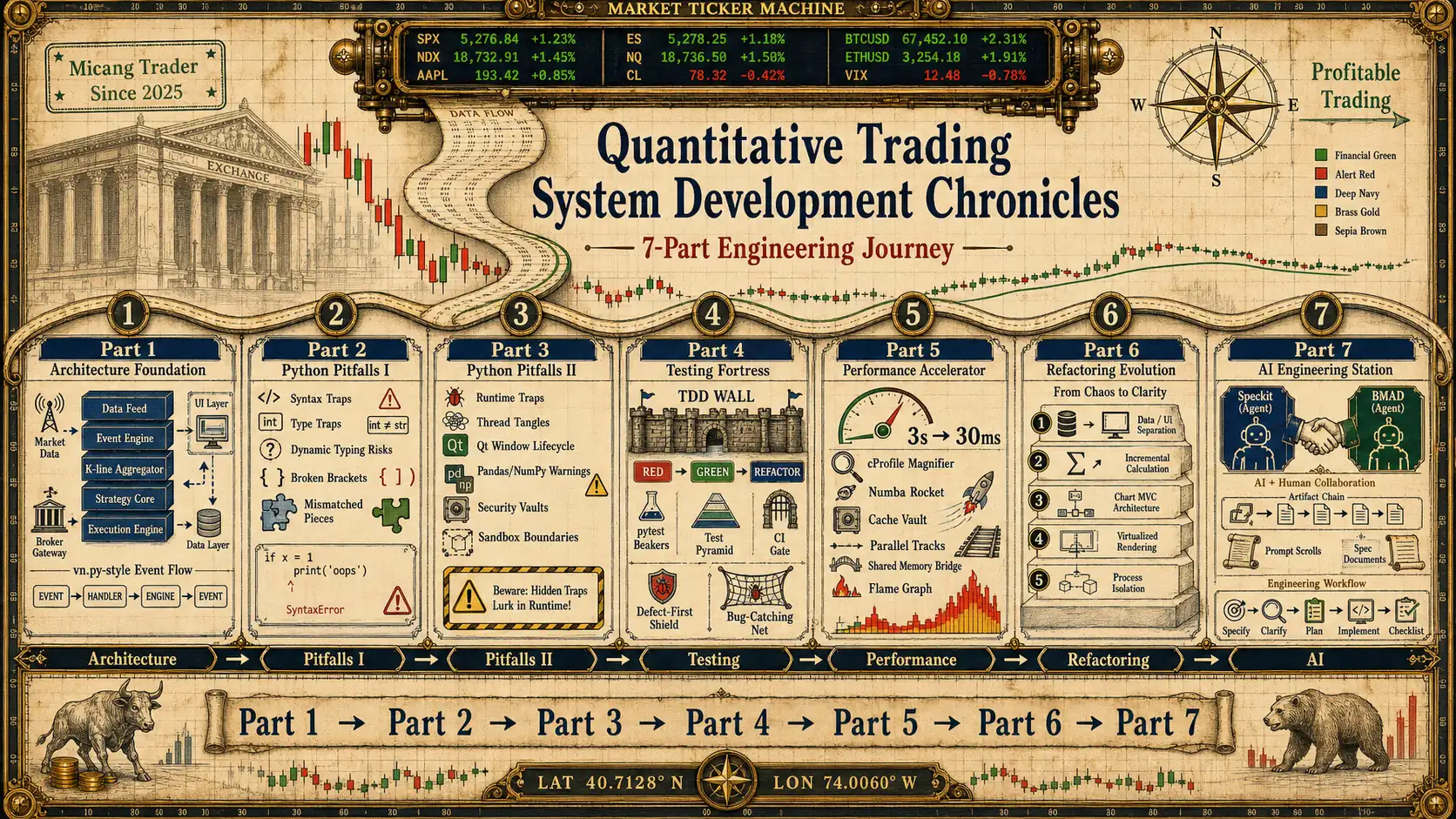
From Micang Trader's system boundaries, data flow, trading periods, backtesting consistency, performance defense lines, test defense lines to architecture evolution, the system reviews how a real-level quantitative trading system is designed, verified and reconstructed.
Progress is stored in this browser only; without saved progress, reading starts from chapter one.
- Status
- Completed
- Difficulty
- Advanced
- Chapters
- 7/7
- Read time
- 240 min
Guide
Series guide
Understand the reading promise, main path, and reference chapters before entering individual articles.
The commitment of this series is clear: not to write a quantitative trading system as a collection of code snippets, but to explain how a runnable system can be split, verified, optimized and evolved based on architectural decisions.
Originality and Scope Statement
This series is an original engineering review based on the author’s Micang Trader project practice. The sample code, diagrams, and process descriptions are used to explain system design trade-offs. They do not constitute a complete strategy, trading signal, or return commitment that can be directly used in live trading.
Mentions of third-party frameworks, trading interfaces, or public materials are technical background references only, and the related rights belong to their original authors or project owners. This content is for learning and technical discussion only. It does not constitute investment advice, trading advice, or any form of financial service. Please quote with the author name and original link.
Who should read it?
- Readers who have already written Python or trading scripts, but want to understand the boundaries of live-level systems.
- Technical lead who is evaluating vn.py, multi-period candlesticks, backtesting and real-time consistency, desktop trading terminals, or AI-assisted development processes.
- Engineering practitioners who want to promote “running strategy scripts” into “trading systems that can be maintained for a long time”.
prerequisite knowledge
Before reading this series, you need to understand the basics of Python, event-driven programming, K-line and matching concepts, common backtest indicators, and the difference in responsibilities between GUI/backend tasks. Readers are not required to be familiar with Micang Trader’s source code; the article will focus on system boundaries and key design trade-offs.
Main line and reference sub-line
It is recommended to read this series as Part1 -> Part2 -> Part3 -> Part4 -> Part5 -> Part6 -> Part7: first establish the system boundary, then look at the real defects, then convert the defects into test defense lines, and then enter the performance management, architecture evolution and AI engineering enhancement layer. Part2 and Part3 can still be reviewed as a Python engineering risk reference article, but it is recommended to fully understand the risk distribution when reading it for the first time.
Recommended reading order
- Read Part 1 first to establish system boundaries, core data flows, and a roadmap of seven articles.
- Continue reading Part2 and Part3 to fully understand how 100 real Python engineering risks enter the trading system.
- Read Part 4 again to understand how these real defects are translated into tests, regression cases, and CI Gates.
- Enter Part 5 to view performance reconnaissance, delay budget, benchmarks and fallback strategies.
- Read Part 6 to review the five refactorings, technical debt and ADR decision-making mechanism.
- Finally, read Part 7 to understand how AI engineering organizes specifications, implementation, review and acceptance into a closed loop.
Responsibilities per article
| Chapter | Responsibilities | Reading style |
|---|---|---|
| Part1 | Architecture entrance: Define system goals, boundaries, data flow, trading period attribution and backtest real-time unified interface | Must-read entrance |
| Part2 | Python pitfalls on: A summary of Python engineering risks related to syntax, types, state, and concurrency | Reference |
| Part3 | Under Python pitfalls: A summary of GUI, network, security, architectural boundaries, and deployment-related risks | Reference |
| Part4 | Testing line of defense: Use a defect-oriented testing system to cover trading periods, data lineage, backtest consistency and CI Gate | Main line |
| Part5 | Performance Optimization: Use performance reconnaissance methods to locate bottlenecks, compress latency, and control optimization side effects | Main line |
| Part6 | Architecture Evolution and Reconstruction Decision: Use Five Reconstructions to Review Architecture Evolution, Debt Management and ADR Decision-making Mechanism | The end of the main plot |
| Part7 | AI Engineering: Explain how AI enters the closed loop of requirements, design, implementation, review and acceptance | capability enhancement layer |
Skip reading rules
If you just want to quickly judge whether this series is suitable for you, just read the system panorama of Part 1 and the target architecture evolution diagram of Part 6. If you are implementing a quantitative system, read in the order Part1 -> Part2 -> Part3 -> Part4 -> Part5 -> Part6 -> Part7; if you are fixing Python or GUI related bugs, you can review by risk group in Part2 and Part3.
Series Path
Read by chapter
Chapter clicks store reading progress only in this browser so the series page can resume from the right entry.
- Quantitative trading system development record (1): five key decisions in project startup and architecture design Taking Micang Trader as an example, this article starts from system boundaries, data flow, trading-session ownership, unified backtesting/live-trading interfaces, and AI collaboration boundaries to establish the architecture thread for the quantitative trading system series.
- Quantitative trading system development record (2): Python Pitfalls practical pitfall avoidance guide (1) Reorganize Python traps from a long list into an engineering risk reference for quantitative trading systems: how to amplify the three types of risks, syntax and scope, type and state, concurrency and state, into real trading system problems.
- Record of Quantitative Trading System Development (Part 3): Python Pitfalls Practical Pitfalls Avoidance Guide (Part 2) Continuing to reorganize Python risks into a reference piece: how GUI lifecycles, asynchronous network failures, security boundaries, and deployment infrastructure affect the long-term stability of quantitative trading systems.
- Quantitative trading system development record (4): test-driven agile development (AI Agent assistance) Starting from a cross-night trading day boundary bug, we reconstruct the test defense line of the quantitative trading system: defect-oriented testing pyramid, AI TDD division of labor, boundary time, data lineage and CI Gate.
- Quantitative trading system development record (5): Python performance tuning practice Transform performance optimization from empirical guesswork into a verifiable investigation process: start from the 3-second chart delay, locate the real bottleneck, compare optimization solutions, and establish benchmarks and rollback strategies.
- Record of Quantitative Trading System Development (6): Architecture Evolution and Reconstruction Decisions Review the five refactorings of Micang Trader, explaining how the system evolved from the initial snapshot to a clearer target architecture, and incorporated technical debt and ADR decisions into long-term governance.
- Quantitative trading system development record (7): AI engineering implementation - from speckit to BMAD Taking the trading calendar and daily aggregation requirements as a single case, explain how AI engineering can enter the delivery of real quantitative systems through specification drive, BMAD role handover and manual quality gate control.