Series · Microservice governance
From enterprise-level CF platform to cloud native: more than ten years of evolution of enterprise-level microservice governance
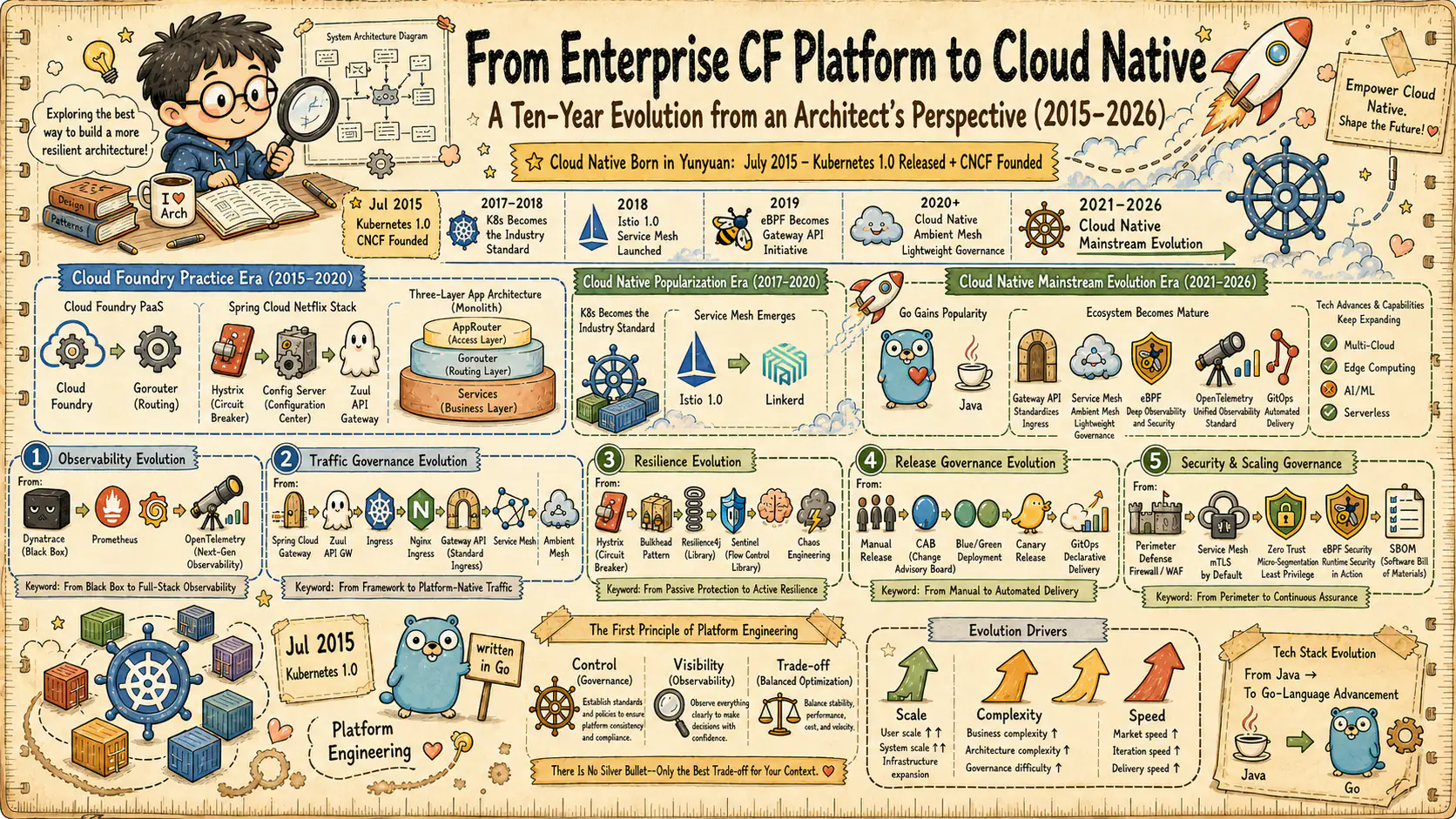
Taking the architectural evolution from enterprise-level Cloud Foundry to cloud-native governance from 2015 to 2026 (to date) as the main line, we systematically review the observations, traffic, resilience, releases, and technical decisions of enterprise-level microservice governance.
Progress is stored in this browser only; without saved progress, reading starts from chapter one.
- Status
- Completed
- Difficulty
- Advanced
- Chapters
- 6/6
- Read time
- 90 min
Guide
Series guide
Understand the reading promise, main path, and reference chapters before entering individual articles.
This series reviews enterprise microservice governance through the long transition from Cloud Foundry platforms to cloud-native runtime and policy systems. The reader should treat it as an architecture evolution map: traffic, observability, resilience, release, and platform governance keep moving downward from application code into standard platform boundaries.
Who should read this series?
- Architects comparing Cloud Foundry-era governance with Kubernetes and service-mesh governance.
- Platform engineers designing traffic, observability, release, or resilience controls.
- Technical leads who need a historical frame for why governance keeps moving from libraries to platforms.
Evolution thread
The main thread is the shift from framework-level microservice patterns to platform-level control planes, data planes, and feedback loops. Each article focuses on one governance dimension and asks what should remain in application code, what should move into infrastructure, and what evidence proves the boundary works.
Responsibilities per article
Part 1 builds the platform baseline. Part 2 explains observability as the decision layer. Part 3 follows traffic governance from gateway and service mesh patterns to newer data-plane approaches. Part 4 focuses on resilience. Part 5 covers release governance. Part 6 summarizes the full governance map and the practical migration path.
Series Path
Read by chapter
Chapter clicks store reading progress only in this browser so the series page can resume from the right entry.
- From enterprise-level CF platform to cloud native (1): Architect's review - the gains and losses of microservice governance in the era of enterprise-level CF platform Based on the front-line architecture practice of enterprise-level CF platforms from 2015 to 2020 and industry observations from 2015 to 2026 (to date), we review the microservice governance design decisions in the Cloud Foundry era and analyze which ones have withstood the test of time and which ones have been reconstructed by the cloud native wave.
- From enterprise-level CF platform to cloud native (2): Observability-driven governance—from monitoring large screens to precise decision-making systems With 6 years of practical experience as an enterprise-level platform architect, we analyze the core position of observability in microservice governance, from data islands to OpenTelemetry unified standards, and build a governance system for accurate decision-making.
- From enterprise-level CF platform to cloud native (3): The evolution of traffic management - from Spring Cloud Gateway to Gateway API and Ambient Mesh Review the practice of Spring Cloud Gateway in the enterprise-level CF platform, analyze the standardization value of Kubernetes Gateway API, explore the evolution logic from Service Mesh to Ambient Mesh, and provide a decision-making framework for enterprise traffic management selection.
- From enterprise-level CF platform to cloud native (4): Redefining elastic fault tolerance—from Hystrix to adaptive governance Review Hystrix's historical position in microservice elastic governance, analyze Resilience4j's lightweight design philosophy, explore new paradigms of adaptive fault tolerance and chaos engineering, and provide practical guidance for enterprises to build resilient systems.
- From enterprise-level CF platform to cloud native (5): The evolution of release governance—from manual approval to progressive delivery Review the manual approval model of traditional release governance, analyze the evolution of blue-green deployment and canary release, explore the new paradigm of GitOps and progressive delivery, and provide practical guidance for enterprises to build an efficient and secure release system.
- From enterprise-level CF platform to cloud native (6): Summary—an architect’s perspective on enterprise-level microservice governance Review the evolution of microservice governance over the past ten years from 2015 to 2026 (to date), refine the first principles of architects, summarize the implementation paths and common pitfalls of enterprise-level governance, look forward to future trends, and provide a systematic thinking framework for technical decision-makers.