Article
From enterprise-level CF platform to cloud native (6): Summary—an architect’s perspective on enterprise-level microservice governance
Review the evolution of microservice governance over the past ten years from 2015 to 2026 (to date), refine the first principles of architects, summarize the implementation paths and common pitfalls of enterprise-level governance, look forward to future trends, and provide a systematic thinking framework for technical decision-makers.
From enterprise-level CF platform to cloud native (6): Summary—an architect’s perspective on enterprise-level microservice governance
After writing the sixth article in this series, I can finally put aside the technical details and look at the evolution of more than ten years from 2015 to 2026 (to date) from a more macro perspective.
When I joined the enterprise-level cloud platform team in 2015, I had an idealized vision of microservice architecture and believed that there were standard answers to technology selection and that best practices could be copied. Judging from the practice in the era of enterprise-level CF platforms, the complexity of enterprise-level systems far exceeds the description in textbooks. In the following five years, we continued to observe from organizations of different industries and sizes, and discovered another level of understanding: technological evolution is not linear substitution, but layered superposition; there is no one-size-fits-all solution, only optimal trade-offs under specific constraints.
This article concludes the series. We no longer focus on the implementation details of a specific technology, but try to answer a more essential question: As an architect, how to establish a stable decision-making framework in the face of numerous and complex technical options? How to find a balance between organizational constraints and technical ideals? How to shift governance capacity building from reactive response to proactive design?
The following is my systematic thinking based on practice and continuous observation from 2015-2026 (to date).
1. Evolution from 2015 to 2026 (to date): from framework to platform to code
1.1 Three-stage division of evolution
Looking back on the more than ten years from 2015 to 2026 (to date), microservice governance has experienced three obvious paradigm shifts. This transformation is not the result of natural iteration of technology, but is driven by three core driving forces: the growth of system scale, the accumulation of business complexity, and the requirement for delivery speed.
Phase 1: Framework Governance (2015-2018)
This stage is typically characterized by partial coupling of governance capabilities with applications. Judging from the practice in the enterprise-level CF platform era, the platform layer uses Cloud Foundry’s native Gorouter to handle service discovery and load balancing, and the application layer mainly uses Spring Cloud Netflix’s Hystrix to implement circuit breaker protection, and Spring Cloud Config for configuration management. This layered architecture is different from the mainstream “full-stack Spring Cloud” practice at the time - the enterprise-level platform team chose a model in which the platform provides basic capabilities and the application focuses on business fault tolerance.
The advantage of this model is the separation of responsibilities: the platform layer handles general network routing, and the application layer accurately controls circuit breakers, timeouts, and degradation strategies through Hystrix. But the disadvantages are equally obvious: governance logic (especially circuit breaker configuration) is coupled with business code, and upgrading Hystrix or adjusting global policies means the need to coordinate multiple service teams. When Hystrix entered maintenance mode in 2017, the company faced not only technical debt, but also a difficult organizational coordination problem.
Phase 2: Platform Governance (2018-2022)
The maturity of Kubernetes and the rise of Service Mesh mark the shift of governance focus from the application layer to the platform layer. Projects such as Istio and Linkerd attempt to sink governance capabilities to the infrastructure layer and achieve transparent inter-service communication management through Sidecar proxies.
The core concept of this stage is “governance is platform capability”. Developers no longer need to worry about the configuration syntax of circuit breaker rules and the implementation details of retry strategies. These capabilities are provided and maintained by the platform team. Service Mesh’s Sidecar model decouples governance logic from business code, achieving the goal of “governance capabilities being independent of the application life cycle”.
But the Sidecar model also brings new problems: resource overhead, network delay, and operation and maintenance complexity. Industry practice shows that in an Istio implementation project in 2020, the memory usage of Sidecar alone increased the infrastructure cost by 30%, and the delay caused by mTLS reached an unacceptable level in certain scenarios. These trade-offs have prompted the industry to start thinking: Where should the boundaries of platform governance be?
Phase 3: Governance as Code (2022 to present)
The current phase is characterized by declarative definition and automated execution of governance policies. The standardization of Kubernetes Gateway API, the popularization of GitOps workflow, the kernel-level observability brought by eBPF, and the entry of AI inference traffic into the governance boundary of gateways and service grids in 2026 are jointly promoting the in-depth evolution of the governance paradigm toward “infrastructure as code”.
The core concept of this stage is “coded governance strategies, automated execution, and closed-loop feedback.” Governance rules are no longer static configuration files, but codes that can be version controlled, reviewed, and automatically tested. More importantly, governance decisions begin to have the ability to self-correct—automatically adjusting strategy parameters based on real-time observation data, forming a complete closed loop of “definition-execution-observation-optimization”.
1.2 Review of the evolution of the five dimensions
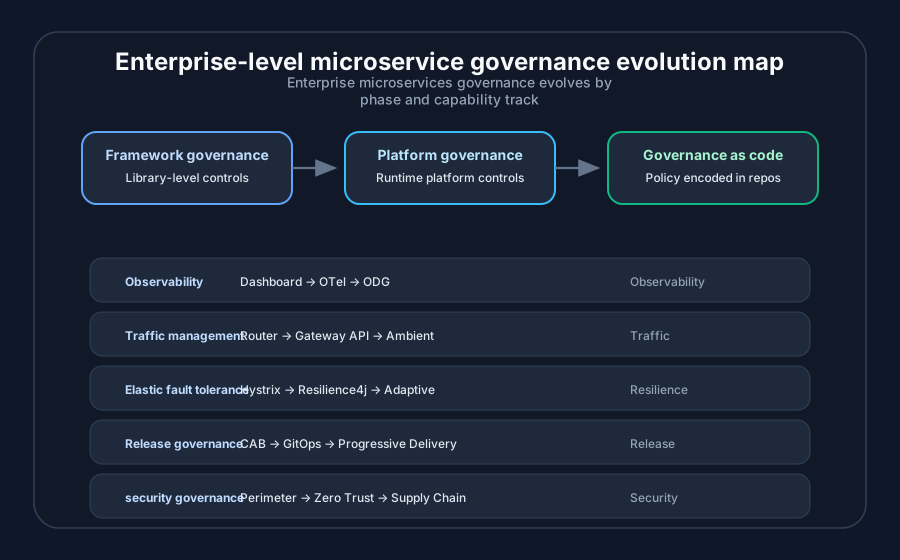
Figure 1: Evolution map of the five dimensions of microservice governance (2015-2026, present)
Observability: From Monitoring to Insights
In the typical evolution of enterprise-level platforms, the combination of Dynatrace, Kibana, and Prometheus represents the characteristics of the first generation of observability tools: data is rich but fragmented. Each tool has its own data format and query syntax, and engineers need to jump between multiple systems to complete a troubleshooting.
The emergence of OpenTelemetry was a turning point. It is not intended to replace existing tools, but to provide a unified data standard and collection framework. The real change has occurred in the past three years: Observability is no longer just a troubleshooting tool, but the basis for governance decisions. Automatically adjust circuit breaker thresholds based on real-time data, predict capacity requirements based on historical patterns, and use tracking data to optimize call chains—these scenarios elevate observability from “post-hoc diagnosis” to the level of “pre-decision-making.”
Traffic Management: From Gateway to Mesh to Ambient
The evolution of traffic management best reflects the iteration of technical paradigms. The original centralized gateways (Zuul, Spring Cloud Gateway) provided unified ingress management, but became a performance bottleneck and single point of failure. Service Mesh’s distributed sidecar solves this problem, but introduces new complexity and resource overhead.
The rise of Ambient Mesh after 2022 represents another swing back: sinking L4 governance capabilities to the node-level ztunnel, and enabling waypoint agents only when L7 governance is required. This layered architecture attempts to find a new balance between performance and control. Industry observations show that more and more enterprises are beginning to adopt the combination of “Gateway API + Ambient Mesh”: north-south traffic is managed through the standardized Gateway API, and east-west communication obtains the necessary governance capabilities in Ambient mode.
Resilient Fault Tolerance: From Fixed Rules to Adaptive Governance
Hystrix’s circuit breaker mode lays the basic concept of elastic governance, but its fixed threshold configuration method often fails in practice. Judging from the practice in the era of enterprise-level CF platforms, many false circuit breakers have occurred: the threshold setting is too conservative, causing normal traffic to be rejected, and the threshold setting is too loose and loses the meaning of protection.
Resilience4j and Sentinel provide more fine-grained control capabilities, but the essence is still static rules. The real breakthrough comes from adaptive governance - dynamically adjusting circuit breaker thresholds and throttling policies based on real-time performance data. Combined with the system resilience verification of chaos engineering, modern elastic governance is shifting from “preset rules” to “continuous learning”.
Release Governance: From Approval to Progressive Delivery
The CAB approval process that enterprise-level platforms went through ten years ago seems almost like a ritual risk control today. The delay and subjective judgment of manual approval form a fundamental contradiction with the rapid iteration required by the microservice architecture.
Blue-green deployments and canary releases transform release risk from “all or nothing” to “progressive exposure.” GitOps further incorporates the release process into version control, enabling changes to be traced and rolled back. Today’s progressive delivery platforms (such as Argo Rollouts, Flagger) combine feature switching, automatic traffic segmentation and metric-driven automatic rollback, taking release governance to a new level of automation.
Security Governance: From Perimeter to Zero Trust
The evolution of security governance is relatively independent, but it has also experienced a transformation from “border protection” to “continuous verification”. mTLS popularized by Service Mesh realizes automatic encryption of communication between services, but this is only the starting point. The core concept of zero trust architecture - never trust, always verify - is being accepted by more and more enterprises.
Supply chain security will become the focus after 2023. The Log4j incident exposed the systemic risks of dependency management, where SBOM (software bill of materials) and signature verification are moving from optional practices to compliance requirements.
1.3 Core driving force of evolution
Technology evolution never occurs in isolation. Looking back at 2015-2026 (to date), three driving forces have always promoted the transformation of the governance paradigm:
Scale driven: When the number of services grows from dozens to hundreds, manual configuration and point-to-point management become unsustainable. Governance must be platform-based and automated.
Complexity-driven: The complexity of the business logic itself has not been reduced, but the distributed deployment model adds new fault dimensions. Governance needs to move from “preventing known risks” to “tolerating unknown failures.”
Speed Drive: Market competition demands faster delivery frequency. Governance cannot be a hindrance to speed but must be integrated into the delivery process in an automated way.
Together, these three drivers point in the same direction: governance must become invisible. The best governance is one that developers don’t feel the existence of governance - it works automatically in the background, only intervenes when necessary, and the intervention method is predictable.
2. The architect’s first principles
During six years of practice and follow-up consulting work on enterprise-level CF platforms, I have participated in dozens of architecture reviews and technology selection decisions. Industry observations indicate a phenomenon: The difference in the quality of many technical decisions lies not in the depth of understanding of specific technologies, but in whether decision-makers have established stable “first principles.”
The so-called first principles refer to those underlying principles that do not change with changes in technological trends. They help architects maintain their sanity in the face of new technologies and maintain professional judgment in the face of organizational pressures.
2.1 Three Principles: Control, Visibility, and Balance
Principle 1: Control is the prerequisite for governance
The essence of governance is control - control of system behavior, control of risks, and control of resources. Without the ability to control, governance is just talk.
I have seen this anti-pattern in many projects: the team introduced Service Mesh to “obtain governance capabilities”, but in fact they did not even sort out the basic network topology. Istio provides rich routing rules and traffic control capabilities, but if the team does not know the current calling relationship, these capabilities become a display.
The premise of control is visibility. You must know the actual operating status of the system in order to develop effective control strategies. This is why I emphasized “observability-driven governance” in my second article - governance decisions must be based on data, not assumptions.
Principle 2: Visibility is the basis for decision-making
Visibility not only refers to monitoring and logging at the technical level, but also includes information transparency at the organizational level. In a typical evolution of an enterprise-level platform, the service dependency map implemented has repeatedly proven to be a high-value governance asset in subsequent consulting work.
Many governance decision-making errors are rooted in opaque information. A team modified the API contract without notifying the downstream, causing online failures; the capacity planning of a certain service was based on outdated assumptions, causing overload during peak periods; the impact assessment of a certain change missed key dependencies, causing cascading failures - what these problems have in common is information silos.
One of the typical responsibilities of the architect role is to establish and maintain visibility mechanisms at the organizational level. This includes visualization of technical assets (service topology, dependency map, performance baseline), as well as transparency at the process level (change notification, impact assessment, post-mortem review).
Principle 3: Tradeoffs are the essence of architecture
There is no perfect architecture, only optimal solutions under specific constraints. The architect’s job is to find a balance between conflicting goals.
The delay brought by Service Mesh vs. control capabilities, the resource overhead of Sidecar vs. independent upgrade capabilities, the automation of GitOps vs. the compliance requirements of approval—these are all trade-offs that must be made. It is important that each trade-off decision be documented and re-evaluated when conditions change.
From the perspective of technological evolution, enterprise-level platforms once promoted a decision of “exchanging delay for visibility”: adding tracking points on the critical path. Although the delay was increased by 5ms, the troubleshooting time was shortened from hours to minutes. This decision was controversial at the time, but later proved to be correct. The key is that we clearly know what we are exchanging for, rather than blindly pursuing a single indicator.
2.2 Decision-making framework for technology selection
When faced with new technologies, I use a four-quadrant framework to aid decision-making:
| Dimensions | key questions | Evaluation criteria |
|---|---|---|
| Technology maturity | Has this technology been proven in a production environment? | Community activity, enterprise adoption rate, version stability |
| organizational fit | Does my team have the capabilities to operate this technology? | Skill reserve, learning cost, operation and maintenance complexity |
| problem solving | Does it solve my most painful problem right now? | Prioritize pain points and compare alternatives |
| exit cost | Can I afford to roll back if I make the wrong decision? | Data migration cost, architectural coupling, vendor lock-in |
This framework helped me filter out many of the temptations of “resume-driven development”. For example, eBPF was evaluated for its potential as an observability solution in 2021. Technically it was revolutionary, but at the time it was judged that the organization’s operational capabilities were not ready to accommodate this level of kernel technology. Re-evaluate after two years. As projects such as cilium/ebpf-go mature and the team’s capabilities improve, the trade-off point for this decision has changed.
2.3 Be wary of the “resume-driven development” trap
There is an implicit incentive misalignment in the technology industry: personal technical growth and organizational technical debt are sometimes satisfied by the same decision at the same time. When an architect chooses a new technology, he may simultaneously gain the opportunity to learn new skills and the risk of introducing technical debt.
Industry observations show that “resume-driven development” has the following typical signals:
- Among the reasons for selection, “this is the future trend” and “all major manufacturers are using it”, but there is no specific business scenario matching.
- As new technology is introduced, the debt of the old system is set aside rather than repaid
- The complexity of the technical solution obviously exceeds the complexity of the problem itself
- Decision makers start looking for application scenarios only after the plan is finalized.
The way to guard against this pitfall is to establish mandatory review of decisions. The typical evolution of enterprise-class platforms requires that every architectural decision must include a comparative analysis of “what are the alternatives that do not adopt this solution?” This approach forces decision-makers to honestly assess the relative merits of current options rather than being swayed by marketing messages about a single technology.
3. Implementation path of enterprise-level governance
The value of a theoretical framework lies in guiding practice. Based on years of implementation experience, the construction path of enterprise-level microservice governance can be divided into four stages. This division is not a strict chronological relationship—some stages can be advanced in parallel, and certain capabilities can be repeatedly strengthened at different stages—but it provides a relatively clear roadmap for capacity building.
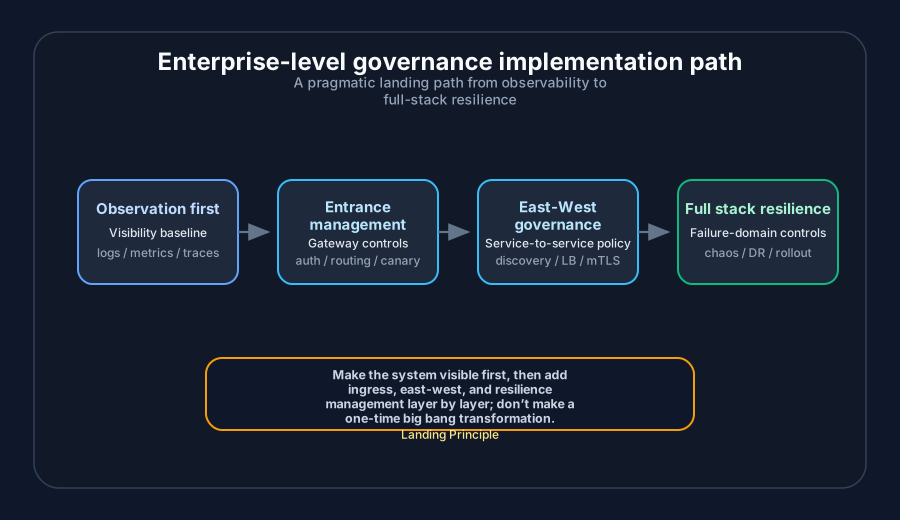
Figure 2: Enterprise-level microservice governance implementation path (observation, entrance, east-west and full-stack resilience)
3.1 Phase 1: Observation first
The second article in this series discusses the idea of observability-driven governance in detail. What I want to emphasize here is: observability is the prerequisite for all subsequent governance capabilities.
I have seen many teams skip this stage and go directly to the deployment of Service Mesh or API gateway. As a result, the formulation of governance strategies becomes blind trial and error. Circuit breaker thresholds without data support, capacity planning without baseline comparison, troubleshooting without trace correlation - these are all common problems when there is a lack of observability foundation.
The core task of observation first is to establish the unity of three dimensions:
Log Unification: From scattered text logs to structured logs, establish a unified log collection and query platform. The key is field standardization - each service should use the same field names to represent related dimensions such as request ID, user ID, service name, etc.
Indicator Unification: Define service-level SLO (service level objective), and establish a collection and visualization system for golden indicators (delay, traffic, errors, saturation). The unification of indicators is more difficult than logs because it involves different collection endpoints (application buried points, infrastructure monitoring, middleware indicators).
Tracking Unification: Deploy a distributed tracking system to ensure that links across service calls are traceable. This is the key link between logs and indicators - through Trace ID, the logs, indicators, and exception stacks of a request can be associated.
In the typical evolution of an enterprise-level platform, the construction of the observation system lasts about 18 months. This cycle sounds long, but it is the cornerstone of all subsequent governance capabilities. The value of investments at this stage will continue to be released in subsequent years.
3.2 Phase 2: Entrance Management
After the observation system is established, the next step is to control how external traffic enters the system. This is the scope of the API gateway’s responsibilities.
The core goal of entrance management is “unified management and control, layered protection”. All external requests should go through the gateway, which handles cross-cutting concerns such as authentication, authentication, current limiting, and circuit breakers.
In the typical evolution of enterprise-level platforms, Spring Cloud Zuul is used and later migrated to Spring Cloud Gateway. Today’s technology selection recommendation is a solution based on the Kubernetes Gateway API - it provides standardized API definitions and avoids the risk of being bound to a specific implementation.
Key decision points for portal governance include:
Number of gateway layers: A single-layer gateway is simple but has limited functions, while a multi-layer gateway is flexible but has increased complexity. A two-layer architecture is usually recommended: edge gateway (processing TLS termination, DDoS protection) + business gateway (processing authentication, routing, current limiting).
Extended account isolation: The extended account system SaaS scenario requires extended account routing to be processed at the gateway layer. This can be achieved via domain name, path prefix or request header, each has its trade-offs.
Grayscale Strategy: The gateway is the natural place to implement canary releases and blue-green deployments. Early grayscale can be based on simple rules (such as specific user IDs), and later evolves into weight-based traffic segmentation.
3.3 Stage Three: East-West Governance
Ingress governance addresses “north-south” traffic (external to internal), while east-west governance focuses on inter-service communication (internal to internal). This is the core battlefield of Service Mesh.
The multiple projects I participated in after 2020 gave me a more pragmatic understanding of Service Mesh: it is not a question of “whether to use it”, but a question of “what scenarios are worth using”.
Typical entry points for east-west governance include:
Inter-Service Authentication: Move from “trust internal network” to “always verify”. mTLS provides automated inter-service identity authentication, which is the foundation of a zero-trust architecture.
Fine-grained traffic control: Routing based on request content (such as directing VIP users to dedicated instances), version-based traffic segmentation (canary release), fault injection (chaos engineering) - these capabilities are most elegantly implemented under the Sidecar architecture.
Enhanced observability: Sidecar proxy can capture network indicators that cannot be sensed by the application layer (such as TCP retransmission, connection establishment time), and supplement the blind spots where applications are buried.
However, the cost of introducing Service Mesh cannot be ignored: the resource overhead of Sidecar (CPU and memory), the delay introduced by the proxy, the complexity of connection management brought by mTLS, and the new technology stack that the operation and maintenance team needs to master.
The current suggestion is: when the number of services exceeds 50, the number of teams exceeds 5, and there is a need for cross-team collaboration, you can consider introducing Service Mesh. Until then, the client-side governance capabilities provided by Spring Cloud or Resilience4j may be sufficient.
3.4 Phase 4: Full-stack Resilience
The first three phases establish basic governance capabilities, and the fourth phase aims to elevate system resilience to a new level.
Full-stack resilience includes three levels:
Fault Tolerance: Proactively verify your system’s fault tolerance through chaos engineering. Chaos engineering, which began in the late stages of enterprise-level platform evolution, has become standard practice today. It is not “waiting for failures to occur and then fixing them”, but “proactively creating failures to verify resilience”.
Elastic Scaling: Automatically adjust resources based on real-time load. Kubernetes’ HPA/VPA is the foundation, and more advanced practices are predictive scaling based on custom indicators (such as queue depth, number of connections).
Disaster recovery and multi-activity: From a single data center to a multi-region deployment. This is not only a technical challenge, but also an organizational coordination challenge in data consistency, traffic scheduling, and failover.
Progressive delivery also falls under this phase. When the infrastructure has sufficient control capabilities, the release process can shift from “approval-driven” to “metric-driven” - automated canary analysis, SLO-based rollback decision-making, and dynamic regulation of feature switches.
3.5 Incremental evolution vs. big bang transformation
There are two models for building enterprise-level governance: incremental evolution and big-bang transformation. Practical experience clearly favors the former.
The risk of big-bang transformation is that it assumes that all problems can be solved at once, but in fact the construction of governance capabilities is continuous and iterative. Industry practice shows that although a large-scale platform migration project—migrating from a self-developed PaaS layer to CF standardization—was ultimately successful, the business interruption, team fatigue, and accumulation of technical debt during the process were all huge hidden costs.
The core of incremental evolution is “delivering value in every iteration”. There is no need to wait for a complete Service Mesh deployment to start governance. You can start with the API gateway and basic circuit breaker strategies. There is no need to wait for a perfect observability system to start making decisions. You can start with log standardization of core services.
What’s more, incremental evolution allows for learning by doing. The effectiveness of governance strategies can only be verified in a real environment, and the theoretical optimal solution may not be applicable under practical constraints. Taking small, fast steps gives you a chance to correct your course before committing too much.
4. Common pitfalls and anti-patterns
In eleven years of practical experience, I have seen many governance projects fail. The reason for failure is often not a lack of technical capabilities, but falling into some kind of thinking trap or anti-pattern. Here are a few of the most common pitfalls.
4.1 Over-engineering: technology for technology’s sake
Over-engineering often does not start from wrong technical judgment, but from a seemingly reasonable desire: now that a new capability has been introduced, we hope that it will cover more scenarios and form a unified standard. The problem is that the greater the coverage of governance capabilities, the better, but whether the problems it solves are enough to offset the complexity after introduction.
Around 2021, some teams encountered this problem when evaluating Service Mesh. The original goal of the plan was to unify traffic governance, observability, and security policies, but as the discussion progressed, the scope gradually expanded to “all services include Istio by default.” This even includes some internal tool services that have few east-west calls. Faced with the question “Why do these services also need Sidecar?”, a common answer is “To unify governance standards.”
This answer sounds correct but doesn’t really answer the cost question. For these low-traffic, low-dependency tool services, the resource overhead, troubleshooting complexity, upgrade costs, and mental burden of operation and maintenance brought by Sidecar may be much higher than the governance benefits they obtain from Mesh. Once technical standards are separated from specific scenarios, they can easily turn from a governance tool into a new burden.
To determine whether it has been over-engineered, you can observe several signals:
- When introducing new technologies, there are only launch goals and no clear exit criteria and success indicators.
- The complexity of the solution obviously exceeds the complexity of the problem itself
- The team spends a lot of time discussing sidecars, control planes, CRDs, and policy templates, but rarely discusses whether business risks are actually reduced.
- “Uniformity” and “standardization” are treated as inherently correct goals, rather than design choices that require proven benefits
To prevent such problems, the most effective question is not “What can this technology do?” but: “What will we lose if we don’t introduce it?” If the loss is unclear, or the loss is significantly less than the cost of introduction, we should postpone it for now and leave governance capabilities to services that really need it.
4.2 Ignoring organizational factors: tools and processes are disconnected
Technology tools are only effective when aligned with organizational processes. In industry practice, we have seen many situations where “the tools are available but no one uses them” - not because the tools are not good, but because the processes are not adjusted accordingly.
A typical example is the introduction of GitOps. Many teams have deployed Argo CD or Flux, but the change approval process is still a manual CAB meeting. As a result, the automated GitOps process is blocked by manual approval, and developers either bypass GitOps and operate the cluster directly, or they lose patience with the slow process.
Another example is observability tools. Enterprises have purchased expensive APM solutions, but engineers still log in to the server to view logs when troubleshooting - because the APM data is not trustworthy enough, or the query syntax is too complex, or the team has not received training.
The key to solving this problem is “process first”. Before introducing tools, clearly define the desired workflow: who is responsible for what, when to do what, and how to measure the results. Then choose tools that support this process, rather than the other way around.
4.3 Static thinking: governance rules remain unchanged
Many teams approach governance policies as static configurations. Once the circuit breaker threshold is set, it will never be adjusted again. Once the current limiting rule is deployed, it will be forgotten. Once the SLO is defined, it will never be reviewed again.
However, the operating characteristics of the system change dynamically. Business loads fluctuate over time, service dependencies adjust with iterations, and the performance characteristics of the infrastructure change. Static governance rules either gradually become ineffective or become too conservative.
In the typical evolution of enterprise-level platforms, the “regular review of governance strategies” mechanism promoted later seems to be still a necessary practice today. Review circuit breakers and current limiting configurations of key services every quarter, adjust SLO thresholds based on actual operating data, and update protection strategies based on fault reviews—these activities ensure that governance capabilities are synchronized with the current status of the system.
A more advanced approach is adaptive governance - allowing the system to automatically adjust policies based on operational data. This is still a cutting-edge area, but even manual periodic reviews are much better than “set it and forget it.”
4.4 Island governance: each team works independently
One risk of microservices architecture is the evolution of team autonomy into technology silos. Each team chooses its own technology stack, its own governance tools, and its own operation and maintenance methods. This improves team efficiency in the short term, but accumulates technical debt for organizational coordination in the long term.
Industry practice shows an extreme case: in the microservice cluster of a medium-sized enterprise, there are four service governance solutions: Spring Cloud, Dubbo, Istio, and Linkerd. Each solution is the “most suitable choice” for a certain team at a certain point in time, but when combined together, it becomes an operation and maintenance nightmare. When global governance policy adjustments (such as unified security hardening) are required, coordination costs are extremely high.
The way to avoid siled governance is to establish a cross-team technical governance committee (or architecture committee, technology radar group). The agency’s role is not to set onerous standards but to:
- Decision-making framework for maintenance technology selection
- Regularly review requests for the introduction of new technologies
- Identify and resolve cross-team dependencies and conflicts
- Disseminate best practices and lessons learned from failures
The key is that this body should have actual decision-making powers and not be purely advisory. Otherwise it will quickly become a mere formality.
5. Future Trend Outlook
Technological evolution doesn’t stop. As of May 2026, some directions that were still considered trends in 2024 have entered the implementation stage; if we still summarize microservice governance from the perspective of 2024, we will miss several changes that have affected architecture selection.
5.1 eBPF reshapes governance boundaries
eBPF (Extended Berkeley Packet Filter) is a technology of the Linux kernel that allows user-defined programs to be safely run in the kernel space. Its impact on microservice governance is profound.
The traditional governance boundary is located in user space - whether it is the application layer SDK or the Sidecar agent, data needs to be copied from the kernel space to the user space, and then copied back after processing. eBPF allows governance logic to be executed directly in the kernel space, eliminating these copy overheads.
The Cilium project demonstrates the potential of eBPF in network governance: the L3/L4 network policy execution performance based on eBPF far exceeds that of iptables; the eBPF program can capture fine-grained network events without modifying the application; the L4 capabilities of Service Mesh can be fully implemented at the eBPF layer, without the need for Sidecar.
By 2026, eBPF is no longer just a “noteworthy” frontier, but has gradually become an underlying capability in Cilium, sidecarless mesh, kernel-level observability, and network policy. It will not replace all existing solutions, but provide a new layer of capabilities - those governance scenarios that are most performance-sensitive and require kernel-level visibility will be the first to migrate to eBPF.
5.2 Gateway API moves from replacing Ingress to a governance standard
2026 will require a fresh look at Gateway APIs. It’s no longer just “better Ingress”, but a common control plane between gateways, service meshes, cross-namespace authorization, and AI inference traffic.
Ingress-NGINX announced in 2025 that it will enter the decommissioning path in 2026. This signal is important: a large number of historical projects used Ingress as the de facto standard, but long-term maintenance and expansion costs have approached the boundary. The value of the Gateway API is not to add a new YAML, but to put role division, routing expression, cross-team authorization and implementation extension into the same standard model.
For architects, this means that the selection problem of ingress governance is changing: in the past, we asked “Which Ingress Controller to choose?”, and now we should ask “whether gateway policies, service mesh policies, and platform permission models can be unified into Gateway API semantics.” If an organization still settles all ingress rules in implementation-private annotations in 2026, future migration and governance costs will continue to rise.
5.3 Ambient Mesh and sidecarless become real options
The core value of Service Mesh has not disappeared, but the cost of the Sidecar model has been fully realized. Istio will continue to promote Ambient Mesh in 2026, indicating that the industry is not giving up on Mesh, but is restructuring the cost model of Mesh.
The value of Sidecarless lies in breaking down governance capabilities into finer levels: Basic L4 security and observability do not require every Pod to carry Sidecar; only traffic that requires L7 policies enters heavier waypoint processing. This layered model is closer to enterprise reality: not all services require full Mesh capabilities, and not all teams can bear the cost of full Mesh operation and maintenance.
Therefore, Mesh selection after 2026 can no longer simply ask “do you want Istio?” A more reasonable question is: Which services only require L4 security? Which services require L7 routing, circuit breaking, and grayscale? Which services should not go into Mesh at all? The governance granularity changes from “global switch” to “stratified by service and risk”.
5.4 Observability enters the stage of Profiling and AI-assisted analysis
OpenTelemetry continues to advance profiling after Trace, Metric, and Log, which will change the boundaries of observability. In the past, observability mainly answered “where did the request go through, where did an error occur, and where did it slow down?”; Profiling added the question of “where are the resources consumed?”
This is critical for microservice governance. Many performance problems cannot be explained by a single request link, but are caused by the superposition of CPU, memory, lock contention, GC, serialization overhead and runtime behavior. After Profiling enters the unified observation system, capacity governance, cost governance and performance governance will be more easily associated with Trace/SLO.
AI-assisted analysis also needs to be understood in this context. It should not be written as a general slogan of “AI automatic operation and maintenance”, but should fall into three specific scenarios: abnormal clustering based on multi-source signals, shortening the troubleshooting path based on historical faults, and giving suggestions for capacity expansion or current limiting based on SLO and cost constraints. Without high-quality observational data, AI will only amplify noise.
5.5 AI-driven adaptive governance
The application of machine learning in governance is still in its early days, but the potential is huge.
Most of the current governance strategies are rule-based: the circuit breaker threshold is fixed, the current limiting rate is preset, and the expansion decision is based on a simple water level. These rules require manual maintenance and are difficult to adapt to complex dynamic environments.
AI can change this landscape in several directions:
- Anomaly Detection: Shift from threshold-based alarms to pattern-based anomaly identification to reduce false positives and false negatives
- Capacity Forecast: Predict load changes based on historical data and business indicators, expand capacity in advance instead of reacting passively
- Strategy Optimization: Automatically adjust governance parameters based on reinforcement learning to find the optimal balance between delay, cost, and availability.
Industry practice shows that in an experimental project in 2023, a model was trained using historical tracking data to predict delay anomalies between services. While there is still room for improvement in accuracy, it is already possible to warn of certain types of performance degradation minutes in advance - which is significant in preventing cascading failures.
The new change in 2026 is that AI inference itself has become a microservice governance object. The traffic of model services has characteristics different from those of ordinary HTTP APIs: request costs vary widely, queuing latency is sensitive, GPU/accelerator resources are scarce, and model versions and supplier routing need to be managed. Gateway API Inference Extension and Istio’s support for inference traffic indicate that AI workloads will repress traditional traffic management, cost management, and capacity management into the same control plane.
5.6 Integration of platform engineering and governance
Platform Engineering is a concept that has emerged in the past two years, emphasizing providing self-service internal developer platforms (IDP) for developers.
The relationship between microservice governance and platform engineering is natural: the abstraction and standardization of governance capabilities are the core responsibilities of the internal platform. When governance policies are defined as reusable platform capabilities, developers can self-service these capabilities through declarative APIs without understanding the underlying implementation details.
One trend I see is that Service Mesh, GitOps, and observability tools are evolving from independent products to components of platform capabilities. The enterprise’s platform team no longer just operates and maintains these tools, but abstracts them into “service governance as a service” and provides them to the application team.
Another aspect of this trend is the popularity of internal developer portals such as Backstage. These portals centrally display governance-related information (service catalog, dependency map, operating status) and become the carrier of governance culture.
5.7 Policy governance returns from external tools to Kubernetes native capabilities
In 2026, Kubernetes itself is also strengthening its governance capabilities. Capabilities such as policies, admission control, resource slicing, and device allocation continue to evolve, indicating that many governance logics that used to rely on external control planes are gradually returning to the Kubernetes native model.
This has two implications for platform teams. First, the platform should not pile all governance capabilities into an independent platform product, but should prioritize whether the native capabilities of Kubernetes are sufficiently expressed. Second, the value of external tools will shift from “filling the gap” to the “orchestration and experience layer”, such as unified templates, approval flows, visualization and developer self-service portals.
5.8 New thinking from microservices to modular monoliths
Finally, I would like to mention a trend that may have been overlooked: rethinking the microservices architecture itself.
In the past decade or so, microservices have almost become synonymous with architectural modernization. But more and more practitioners are beginning to realize that microservices are not a silver bullet - they solve certain problems (team autonomy, technical diversity), but also create new problems (distributed complexity, operation and maintenance overhead, data consistency).
Industry observations indicate that an interesting phenomenon in 2023 is that some companies are beginning to explore “Modular Monolith” as an alternative or front-end solution to microservices. Through clear module boundaries, internal API contracts, and independent deployment units (but shared runtime), modular monoliths attempt to avoid the complexity of distributed systems while maintaining code-level clarity.
This is not a rejection of microservices, but a rethinking of “appropriate sizing”. For some organizations, 10 services may be more appropriate than 100 services; for some stages, a modular monolith may be better at balancing evolution speed and operation and maintenance complexity than microservices.
From a governance perspective, this means that governance capacity building needs to remain flexible—do not assume that the system will evolve to a specific architectural form, but allow governance capabilities to adapt to different architectural choices.
6. Suggestions for architects
At this point, I would like to summarize some suggestions for fellow architects. These suggestions are based on lessons learned and may not necessarily apply to all scenarios, but hopefully provide some food for thought.
6.1 How to evaluate new technologies
When facing new technologies, I recommend adopting a “delayed adoption” strategy: instead of following every new trend immediately, let the technology withstand the test of at least 12-18 months in a production environment before considering introducing it.
Specific framework for assessment:
- Problem fit: Does this technology solve my current most painful problem? Or does it just “look cool”?
- Maturity Assessment: How much validation is there in production? What is the long-term commitment of the community?
- Organizational Readiness: Is the team capable of operating this technology? How steep is the learning curve?
- Exit strategy: If the decision is wrong, what is the cost and path of going back?
6.2 How to balance short-term income and long-term debt
Technical debt is inevitable, the key is to control its size and growth rate.
My approach is to clearly distinguish between “strategic debt” and “lazy debt”. Strategic debt is a temporary compromise intentionally undertaken to seize market opportunities, with a clear repayment plan; lazy debt is a problem accumulated due to a lack of process or lack of awareness, which is often hidden and out of control.
Every time you make a technology decision, ask: “What kind of debt is this choice accumulating?” If it’s strategic debt, make sure you have a plan to repay it; if it’s lazy debt, reject it.
6.3 How to build a governance culture
Building technical capabilities is relatively easy, but building culture is truly difficult.
At the heart of governance culture is “shared responsibility.” Every team should understand: reliability is not the exclusive responsibility of the operation and maintenance team, but the common responsibility of all engineers; security is not the separate work of the security team, but a necessary perspective for every code review.
Ways to build a governance culture:
- Metric-driven: Clearly defined SLOs allow everyone to see the true health status of the system
- Review Transparency: Fault review should not have a blame culture, but should focus on systemic improvements
- Knowledge Sharing: Regularly organize cross-team technology sharing to disseminate best practices and lessons learned from failures.
- Tool Democracy: Make governance tools easy to use and lower the threshold for following governance norms
6.4 Methods of continuous learning
Architects must keep learning, but the focus of learning should be selective.
I recommend dividing your study time into three parts:
- 60% Go deep into existing fields: Have a craftsman-level understanding of the technology being used, rather than staying at a conceptual level
- 30% Expand adjacent fields: Understand changes in upstream and downstream technologies and establish a global perspective
- 10% Explore cutting-edge trends: Stay sensitive to new technologies, but don’t rush to adopt them
The form of learning is also important. Reading documentation and blogs is the basics, but the most valuable learning comes from practice and peer interaction. Participate in open source communities, attend technical conferences, network with fellow architects—these activities often have a higher ROI than delving alone.
Conclusion
From 2015 to 2026 (to date), the understanding of microservice governance has changed a lot.
When I first joined the enterprise cloud platform team, I had an idealized understanding of technology selection and believed that best practices could be replicated. The practice in the era of enterprise-level CF platforms has made enterprises realize the complexity of enterprise-level systems; subsequent observations in different organizations have revealed that the challenges faced by similar technology stacks may be completely different.
Today’s point is: there is no standard answer to microservice governance, only trade-offs under specific constraints. A good architect is not someone who knows all the answers, but someone who can make sound decisions in the face of uncertainty. This ability comes from adhering to first principles, understanding organizational constraints, and grasping technological evolution trends.
This series of articles documents the evolution of thinking in this field. From the framework governance in the enterprise-level CF platform era, to the platform governance in the Kubernetes era, to today’s new paradigm of code-based and adaptive governance - the specific form of technology is constantly changing, but the essence of governance remains the same: finding a dynamic balance between scale, speed, and reliability, and making a rational trade-off between control and flexibility.
I hope these experiences have inspired you. The road to technology is long, and we must learn as we go.
About the author
Milome has more than ten years of experience in enterprise-level architecture design. He has served as a senior architect for enterprise-level CF platforms and has led the architecture design and implementation of multiple large-scale microservice platforms. Currently focusing on the research and practice of cloud native technology architecture and governance system.
*This article is the sixth article (summary) in the series “From Enterprise-level CF Platform to Cloud Native: More than Ten Years of Evolution of Enterprise-level Microservice Governance”. The first five articles respectively discussed the governance architecture, observability-driven governance, traffic governance evolution, elastic fault tolerance redefinition, and release governance evolution in the era of enterprise-level CF platforms. *
Reference and further reading
- Kubernetes Ingress NGINX Retirement Announcement: https://kubernetes.io/blog/2025/11/11/ingress-nginx-retirement/
- Kubernetes v1.36 Release Announcement: https://kubernetes.io/blog/2026/04/22/kubernetes-v1-36-release/
- Istio 1.29 Release Announcement: https://istio.io/latest/news/releases/1.29.x/announcing-1.29/
- OpenTelemetry Profiles Public Alpha: https://opentelemetry.io/blog/2026/profiles-alpha/
- Gateway API Inference Extension: https://gateway-api-inference-extension.sigs.k8s.io/
Series context
You are reading: From enterprise-level CF platform to cloud native: more than ten years of evolution of enterprise-level microservice governance
This is article 6 of 6. Reading progress is stored only in this browser so the full series page can resume from the right entry.
Series Path
Current series chapters
Chapter clicks store reading progress only in this browser so the series page can resume from the right entry.
- From enterprise-level CF platform to cloud native (1): Architect's review - the gains and losses of microservice governance in the era of enterprise-level CF platform Based on the front-line architecture practice of enterprise-level CF platforms from 2015 to 2020 and industry observations from 2015 to 2026 (to date), we review the microservice governance design decisions in the Cloud Foundry era and analyze which ones have withstood the test of time and which ones have been reconstructed by the cloud native wave.
- From enterprise-level CF platform to cloud native (2): Observability-driven governance—from monitoring large screens to precise decision-making systems With 6 years of practical experience as an enterprise-level platform architect, we analyze the core position of observability in microservice governance, from data islands to OpenTelemetry unified standards, and build a governance system for accurate decision-making.
- From enterprise-level CF platform to cloud native (3): The evolution of traffic management - from Spring Cloud Gateway to Gateway API and Ambient Mesh Review the practice of Spring Cloud Gateway in the enterprise-level CF platform, analyze the standardization value of Kubernetes Gateway API, explore the evolution logic from Service Mesh to Ambient Mesh, and provide a decision-making framework for enterprise traffic management selection.
- From enterprise-level CF platform to cloud native (4): Redefining elastic fault tolerance—from Hystrix to adaptive governance Review Hystrix's historical position in microservice elastic governance, analyze Resilience4j's lightweight design philosophy, explore new paradigms of adaptive fault tolerance and chaos engineering, and provide practical guidance for enterprises to build resilient systems.
- From enterprise-level CF platform to cloud native (5): The evolution of release governance—from manual approval to progressive delivery Review the manual approval model of traditional release governance, analyze the evolution of blue-green deployment and canary release, explore the new paradigm of GitOps and progressive delivery, and provide practical guidance for enterprises to build an efficient and secure release system.
- From enterprise-level CF platform to cloud native (6): Summary—an architect’s perspective on enterprise-level microservice governance Review the evolution of microservice governance over the past ten years from 2015 to 2026 (to date), refine the first principles of architects, summarize the implementation paths and common pitfalls of enterprise-level governance, look forward to future trends, and provide a systematic thinking framework for technical decision-makers.
Reading path
Continue along this topic path
Follow the recommended order for Microservice governance instead of jumping through random articles in the same topic.
Next step
Go deeper into this topic
If this article is useful, continue from the topic page or subscribe to follow later updates.
Loading comments...
Comments and discussion
Sign in with GitHub to join the discussion. Comments are synced to GitHub Discussions