Article
From enterprise-level CF platform to cloud native (4): Redefining elastic fault tolerance—from Hystrix to adaptive governance
Review Hystrix's historical position in microservice elastic governance, analyze Resilience4j's lightweight design philosophy, explore new paradigms of adaptive fault tolerance and chaos engineering, and provide practical guidance for enterprises to build resilient systems.
From enterprise-level CF platform to cloud native (4): Redefining elastic fault tolerance—from Hystrix to adaptive governance
Around 2016, the author dealt with a difficult production incident in the enterprise cloud platform team. At that time, the core order service had just been migrated from a monolithic architecture to microservices, and everything seemed to be going according to plan—until early one morning, a downstream inventory service responded slowly due to exhaustion of the database connection pool. This originally inconspicuous failure turned into a cascading crash within three hours: the order service thread pool was full, the payment service timed out while waiting for order confirmation, and finally even the most basic authentication service became unavailable.
That accident gave me a deep understanding of the “fragility paradox” of distributed systems for the first time - a glitch in a single component, without appropriate protection mechanisms, will spread at an exponential rate along the call chain. The team at that time adopted Netflix Hystrix as a fault-tolerant solution, but tuning configuration parameters became a “black magic”: if the threshold was set too low, normal traffic would be misjudged; if it was set too high, the protection would be lost.
This article will review the evolution from Hystrix to modern adaptive elastic governance, share the practical experience accumulated from the enterprise-level CF platform and subsequent industry consulting work, and explore the technical path to build a truly resilient system.
1. The Hystrix era: the classic foundation of the circuit breaker model
1.1 The design philosophy behind Netflix’s open source
In 2012, Netflix open sourced Hystrix, the fault-tolerance framework it used internally. The motivation behind this decision stems from the painful lessons Netflix learned during its migration to cloud computing. As a streaming media platform that handles billions of requests every day, Netflix also experienced numerous cascading failures in its early days. Ben Christensen, the designer of Hystrix, wrote in a blog: “In distributed systems, failure is not the exception, but the norm.”
Hystrix’s design philosophy is built on several core principles:
First, failing fast is better than failing slowly. Traditional timeout waiting will occupy precious thread resources, but Hystrix uses the circuit breaker mode to quickly reject the request after detecting the failure mode, allowing the caller to adopt a downgrade strategy in time.
Second, resource isolation is the first line of defense against cascading failures. Hystrix allocates an independent thread pool for each dependent service, and the failure of one service will not consume all the computing resources of the application.
Third, real-time monitoring and dynamic adjustment. Hystrix provides a wealth of metrics, including success rate, delay distribution, thread pool occupancy, etc., allowing the operation and maintenance team to make decisions based on data.
Judging from the practice in the early stages of the industry, Hystrix’s design concept was groundbreaking at the time. Compared with the simple try-catch retry mode that was popular at the time, Hystrix provided a systematic solution. However, from the perspective of technological evolution, its complexity is also worth noting-especially in the choice of resource isolation strategy.
1.2 Thread pool isolation vs semaphore isolation
Hystrix provides two isolation mechanisms. This choice was a common trouble in the early practice of the industry.
Thread Pool Isolation is the default mode of Hystrix. Each dependent service has an independent thread pool, and requests are executed in independent threads. The advantages of this model are obvious:
- Complete resource isolation: slow requests to one service will not block other services
- Requests can time out: setting a timeout in the main thread can interrupt the execution thread
- Graceful degradation: When the thread pool is full, the request can be rejected directly without waiting.
But the cost is equally significant. Threads come at a cost - each thread requires about 1MB of stack space, and context switching also has overhead. Judging from the practice in the era of enterprise-level CF platforms, when the number of dependent services exceeds 50, the memory overhead caused by thread pool isolation cannot be ignored.
Semaphore Isolation is a more lightweight alternative. It limits the number of concurrencies through semaphores, and requests are executed in the same thread. This method saves the overhead of thread switching, but it also has obvious limitations: it cannot set a timeout (because the execution thread cannot be interrupted), and the downgrade timing is not as flexible as thread pool isolation.
The strategy adopted in industry practice is a mixture of thread pool isolation for critical, potentially long-running external calls and semaphore isolation for internal service calls or requests with extremely short response times expected. This hybrid strategy reduces the number of threads in an order processing system for a typical enterprise-level project from 300+ to about 80, while maintaining the necessary isolation.
1.3 Implementation mechanism of circuit breaker state machine
The core of the Hystrix circuit breaker is a finite state machine. From the perspective of technological evolution, this model has universal value.
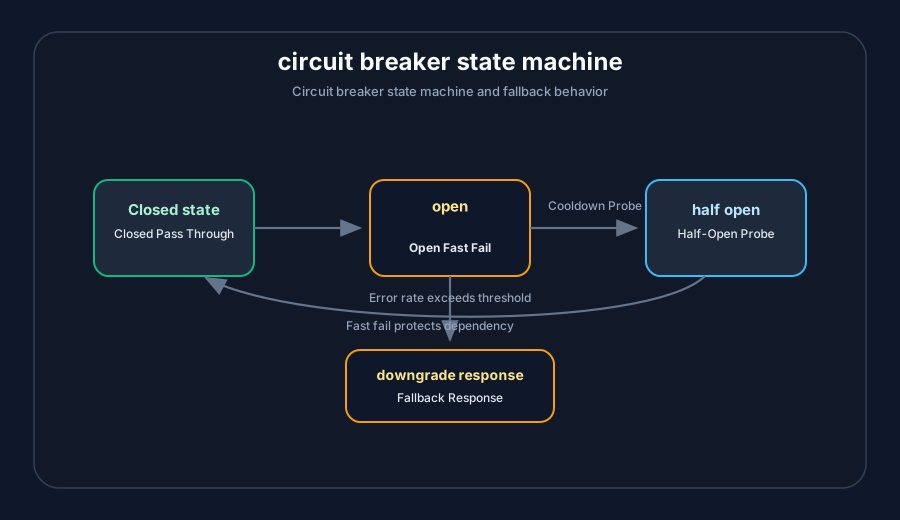
Figure 1: Circuit breaker state machine (Closed, Open, Half-Open and Fallback)
CLOSED (closed) state: The circuit breaker is closed and the request passes normally. Hystrix maintains a sliding window of statistics and calculates the error rate over the most recent period. When the error rate exceeds the set threshold (default 50%) and the request volume reaches the minimum threshold (default 20 requests), the status transitions to OPEN.
OPEN (disconnected) state: The circuit breaker is open, all requests immediately fail and downgrade logic is executed. Hystrix will start a timer and automatically transition to the HALF_OPEN state when the timeout reaches (default 5 seconds).
HALF_OPEN (half-open) state: allows a limited number of trial requests to pass (default 1). If these requests succeed, the circuit breaker returns to the CLOSED state; if it fails, it returns to the OPEN state and resets the timer.
The design genius of this state machine lies in its ability to self-heal. Judging from the practice in the era of enterprise-level CF platforms, instantaneous failures caused by network jitter are common scenarios - after the circuit breaker waits in the OPEN state for a few seconds, the service has often returned to normal. The HALF_OPEN mechanism allows the system to automatically recover without manual intervention.
But problems also arise: the default 5-second timeout is not applicable in many scenarios. For core payment services, 5 seconds of unavailability means huge business losses; for non-critical background synchronization tasks, 5 seconds may be too short, resulting in unnecessary circuit breaker. Configuring these parameters requires a deep understanding of the business characteristics and SLAs of the dependent services.
1.4 Enterprise-level Hystrix practical experience and common pitfalls
Hystrix has been widely used in typical enterprise-level projects such as early enterprise-level PaaS. These practices not only gained valuable experience, but also exposed some common pitfalls.
Pit 1: Production trap with default configuration
Hystrix’s default parameters are optimized for Netflix scenarios, but are not suitable for all situations. A typical problem has been encountered in typical enterprise-level projects: the error rate of a certain service always hovers around 45%, and the circuit breaker is never triggered, but it continues to affect the user experience. After investigation, it was found that the request volume of the service was small and could not reach the default window threshold of 20 requests/10 seconds. Error requests are diluted in a large number of statistical periods, and the circuit breaker is ineffective.
The solution is to lower the threshold of the statistics window for low-frequency services:
HystrixCommandProperties.Setter()
    .withCircuitBreakerRequestVolumeThreshold(5)
    .withCircuitBreakerSleepWindowInMilliseconds(3000)
    .withCircuitBreakerErrorThresholdPercentage(30)
Pit 2: Complexity of cascade downgrade
When multiple services are disconnected at the same time, the downgrade logic itself will also face resource pressure. An exquisite downgrade chain has been designed in industry practice cases: when the main service is disconnected, the backup service is called, when the backup service is disconnected, cached data is returned, and when the cache is unavailable, static default values are returned. However, in a large-scale failure, the backup service was also shut down, the cache service timed out due to high concurrent queries, and eventually the entire downgrade chain collapsed.
From a technology evolution perspective, the downgrade strategy itself also needs protection. Independent timeout controls and resource limits should be included at each degradation step.
Pit 3: Monitoring blind spots
Hystrix Dashboard provides real-time circuit breaker status visualization, but it relies on SSE (Server-Sent Events) to continuously push data. In high-concurrency scenarios, the Dashboard itself becomes a performance bottleneck. In typical enterprise-level projects, multiple Dashboard instances have to be deployed and the data aggregated through the aggregation layer.
1.5 Technical impact of Hystrix stopping maintenance
At the end of 2018, Netflix announced that it would stop active maintenance of Hystrix. This decision is not that Hystrix is not good enough, but that Netflix’s technology stack has evolved to a new stage. They use more adaptive fault tolerance mechanisms rather than statically configured circuit breakers.
News of the cessation of maintenance sparked widespread discussion in the technology community. For businesses that rely on Hystrix, this means several practical issues:
Security Risk: Security vulnerabilities are no longer fixed, and enterprises need to maintain their own patch branches.
Ecological Disconnect: After the Spring Cloud Dalston version, Spring officially began to recommend Resilience4j as an alternative.
Technical Debt: Continuing to use a framework that is no longer maintained will become a penalty item in the architecture review.
Judging from the practice in the early stages of the industry, I was responsible for evaluating the migration plan. After comparative testing, I finally chose Resilience4j. This decision was based on several considerations: lightweight design, functional programming model, active community maintenance, and good integration with the Spring ecosystem.
2. The rise of Resilience4j: the victory of lightweight and modularity
2.1 Starting afresh from the legacy of Hystrix
Resilience4j is an open source project created by Robert Winkler in 2016 to provide a lightweight fault-tolerance library. Compared with Hystrix, its design starting point is completely different:
Does not rely on external thread pool: Resilience4j’s circuit breaker is executed entirely in the calling thread, and state transitions are managed through configuration rather than thread isolation. This greatly reduces resource overhead.
Functional programming model: Make full use of Java 8’s Lambda and functional interfaces to encapsulate fault-tolerant logic into composable decorators.
Modular Architecture: The core module only contains the circuit breaker function, and other functions (retry, current limiting, bulkhead isolation) are provided as independent modules.
Judging from the intuitive feeling during the migration process, the simplicity of the code is a significant advantage of Resilience4j. Hystrix requires inheriting the HystrixCommand class or using complex constructor patterns, while Resilience4j can apply fault-tolerance logic as a higher-order function:
// Hystrix
public class OrderCommand extends HystrixCommand<Order> {
    protected Order run() {
        return orderService.fetchOrder(id);
    }
    protected Order getFallback() {
        return Order.empty();
    }
}

// Resilience4j
Supplier<Order> decorated = CircuitBreaker
    .decorateSupplier(circuitBreaker, () -> orderService.fetchOrder(id));
Order order = Try.ofSupplier(decorated)
    .recover(throwable -> Order.empty())
    .get();
This functional style not only makes the code simpler, but more importantly facilitates unit testing - fault-tolerant logic can be easily mocked or replaced.
2.2 Technical analysis of core modules
The modular design of Resilience4j allows functions to be introduced on demand, avoiding the “family bucket” dependence of Hystrix.
CircuitBreaker module
Resilience4j’s circuit breaker has made many improvements based on Hystrix:
- Count-based sliding window: In addition to Hystrix’s time window, it also supports windows based on the number of requests, which is more suitable for low-frequency services.
- Slow call proportional circuit breaker: The circuit breaker can be triggered not only based on the error rate, but also based on the proportion of slow calls (exceeding the set threshold).
- Custom state listener: You can register a callback function to trigger notifications or logs when the state transitions.
CircuitBreakerConfig config = CircuitBreakerConfig.custom()
    .failureRateThreshold(50)
    .slowCallRateThreshold(80)
    .slowCallDurationThreshold(Duration.ofSeconds(2))
    .slidingWindowType(SlidingWindowType.COUNT_BASED)
    .slidingWindowSize(100)
    .build();
In the Internet of Things data processing project, the slow call circuit breaker feature has been successfully applied. In this scenario, the downstream service rarely fails completely, but often responds slowly due to the large amount of data. The traditional error rate circuit breaker is almost never triggered, while the slow call proportion circuit breaker successfully identifies performance degradation and triggers the degradation logic in advance.
Retry module
Retry is a seemingly simple but actually complex issue in distributed systems. Resilience4j’s Retry module provides:
- Exponential Backoff: Avoid the impact of retry storms on failed services
- Random Jitter (Jitter): Prevent traffic peaks caused by simultaneous retries of multiple clients
- Conditional retry: Determine whether to retry based on exception type or custom predicate
RetryConfig config = RetryConfig.custom()
    .maxAttempts(3)
    .waitDuration(Duration.ofMillis(100))
    .exponentialBackoffMultiplier(2.0)
    .retryExceptions(IOException.class, TimeoutException.class)
    .ignoreExceptions(BusinessException.class)
    .build();
The combination of exponential backoff plus dither is the most commonly used configuration in industry practice. In the docking scenario between the enterprise-level CF platform and external logistics providers, this strategy not only gives the other party a time window for service recovery, but also avoids traffic peaks caused by multiple instances retrying at the same time.
RateLimiter module
Current limiting is a key means to protect services from being overwhelmed by overloaded requests. Resilience4j implements two current limiting algorithms: token bucket and license-based.
RateLimiterConfig config = RateLimiterConfig.custom()
    .limitRefreshPeriod(Duration.ofSeconds(1))
    .limitForPeriod(100)
    .timeoutDuration(Duration.ofMillis(500))
    .build();
Deploying Resilience4j’s current limiter at the API gateway layer is a common practice to protect backend services. Compared with traditional Bucket4j, Resilience4j has better asynchronous support and smoother integration with the Reactive programming model.
Bulkhead Module (Bulkhead Isolation)
Bulkhead isolation is a pattern emphasized in the book “Release It!”. Resilience4j provides two implementations:
- Semaphore bulkhead: Limits the number of concurrent calls, similar to Hystrix’s semaphore isolation
- Thread Pool Bulkhead: Assign an independent thread pool to each bulkhead
ThreadPoolBulkheadConfig config = ThreadPoolBulkheadConfig.custom()
    .maxThreadPoolSize(10)
    .coreThreadPoolSize(5)
    .queueCapacity(20)
    .build();
Bulkhead isolation is particularly valuable in extended account system systems. When designing for a SaaS platform, assigning independent bulkheads to each important expansion account can effectively prevent the “noisy neighbor” problem from affecting other expansion accounts.
TimeLimiter module
Timeout control seems simple, but it is error-prone in asynchronous programming. TimeLimiter integrates with Java’s CompletableFuture and RxJava to provide a reliable timeout mechanism.
TimeLimiterConfig config = TimeLimiterConfig.custom()
    .timeoutDuration(Duration.ofSeconds(3))
    .cancelRunningFuture(true)
    .build();
2.3 Deep integration with Spring ecosystem
The integration of Resilience4j with Spring Boot is an important reason for its rapid popularity. The Spring Cloud Circuit Breaker abstraction layer unifies the interfaces of different implementations, and Resilience4j’s Spring Boot Starter provides declarative annotation support.
Annotation driven programming
@Service
public class OrderService {

    @CircuitBreaker(name = "orderService", fallbackMethod = "getOrderFallback")
    public Order getOrder(String id) {
        return restTemplate.getForObject(
            "http://order-service/orders/" + id, Order.class);
    }

    @TimeLimiter(name = "orderService")
    @Bulkhead(name = "orderService")
    public CompletableFuture<Order> getOrderAsync(String id) {
        return CompletableFuture.supplyAsync(() -> getOrder(id));
    }

    private Order getOrderFallback(String id, Exception ex) {
        return Order.empty(id);
    }
}
Externalized Configuration
Resilience4j supports configuring all parameters through YAML or Properties files, which is consistent with Spring Boot’s configuration philosophy:
resilience4j:
  circuitbreaker:
    instances:
      orderService:
        slidingWindowSize: 100
        failureRateThreshold: 50
        waitDurationInOpenState: 30s
  retry:
    instances:
      orderService:
        maxAttempts: 3
        waitDuration: 100ms
In the cloud migration project, the externalized configuration feature was used to achieve differentiated configurations for different environments: the production environment adopted a more conservative circuit breaker strategy, while the development and testing environment was more relaxed to facilitate problem troubleshooting.
Metrics and Monitoring
Resilience4j integrates with monitoring systems such as Prometheus and Datadog through Micrometer to provide a wealth of metrics:
- Number of circuit breaker status transitions
- Success rate/failure rate/ignore rate
- Slow call ratio
- Distribution of retries
- Current limiter waiting time
2.4 Performance comparison: Resilience4j vs Hystrix
Around 2019, I led a performance comparison test to evaluate the benefits of migrating from Hystrix to Resilience4j. The test environment uses JMH (Java Microbenchmark Harness) to simulate typical microservice calling scenarios.
| index | Hystrix (thread pool) | Hystrix (Semaphore) | Resilience4j |
|---|---|---|---|
| Average latency (no faults) | 0.85ms | 0.12ms | 0.08ms |
| P99 delay (no glitches) | 1.20ms | 0.25ms | 0.15ms |
| Memory usage (100 dependencies) | ~300MB | ~80MB | ~45MB |
| Throughput (normal state) | 45,000 RPS | 85,000 RPS | 120,000 RPS |
| Throughput (circuit breaker status) | 180,000 RPS | 180,000 RPS | 250,000 RPS |
The test results verified the lightweight advantages of Resilience4j:
- Latency reduction: In a fault-free scenario, the average latency of Resilience4j is 1/10 of the Hystrix thread pool mode and 2/3 of the semaphore mode.
- Memory Savings: In 100 dependent service scenarios, the memory overhead of Resilience4j is 1/7 of the Hystrix thread pool mode
- Throughput Improvement: Throughput is increased by 60-165% under normal conditions and 38% under circuit breaker conditions.
However, industry observations show that in high-concurrency circuit breaker scenarios, Resilience4j’s CPU usage is slightly higher than that of Hystrix. In-depth analysis found that this is because Resilience4j’s state machine is executed in the calling thread, while Hystrix’s circuit breaker judgment is performed in an independent monitoring thread. This trade-off is worthwhile in most scenarios, but you need to pay attention to scenarios with extremely high concurrency and a large number of circuit breakers.
2.5 Limitations and boundaries of Resilience4j
Resilience4j is not a panacea. It has several limitations found in industry practice:
Distributed circuit breaker is not supported
Resilience4j’s circuit breaker state is maintained in-process. Circuit breaker status cannot be shared between multiple instances. This means that if a downstream service triggers a circuit breaker on instance A, instance B will still continue to send requests until it detects the failure itself. In scenarios where cluster-level circuit breakers are required, additional coordination mechanisms (such as Redis or ZooKeeper) are required.
Lack of adaptive ability
Like Hystrix, Resilience4j’s parameters are statically configured. Once set, it does not automatically adjust based on traffic patterns or system load. This may lead to invalid or overly conservative configurations in scenarios with large traffic fluctuations.
Limitations of Reactive Programming
Although Resilience4j supports Reactor and RxJava, the integration in emerging asynchronous models such as Kotlin coroutines is not complete enough. When used in a Kotlin project, an adaptation layer has to be written to handle the context transfer of the coroutine.
3. Adaptive fault tolerance: from static configuration to dynamic governance
3.1 Dilemma of traditional static configuration
Both Resilience4j and Hystrix rely on manually configured parameters, a model that faces fundamental challenges in complex distributed systems.
Parameter drift problem
Microservice dependencies change dynamically. The service called today may be replaced tomorrow; today’s SLA is 99.9%, but tomorrow it may become 99.99% due to infrastructure upgrades. Static configuration cannot adapt to this change and gradually becomes no longer suitable.
In the project tracking that lasted for many years, it was observed that the circuit breaker threshold initially set gradually became invalid during the system evolution. The new team members did not understand the original configuration basis and could only make adjustments based on their feelings, eventually forming a set of “magic numbers” that no one understood.
Changes in Traffic Patterns
Traffic characteristics vary greatly in different time periods. The traffic of the e-commerce system during the promotion period may be ten times that of normal times, and the response time distribution of the API is also completely different. The fusing parameters optimized for normal times may be too sensitive in high-traffic scenarios; while the parameters optimized for peak values may not provide sufficient protection during normal times.
Difficulty in identifying multi-dimensional faults
Traditional circuit breakers only focus on two outcomes: success or failure, but failures in reality are more subtle. A service may succeed in most requests, but certain types of requests continue to fail; or instances in some areas may be normal while instances in other areas may be abnormal. Coarse-grained fuses may cause accidental injuries.
3.2 Dynamic adjustment based on load
The core idea of adaptive fault tolerance is to let the system automatically adjust protection parameters according to real-time status.
Google’s SRE practices
Google proposed the concept of “adaptive current limiting” in the SRE (Site Reliability Engineering) manual. The basic idea is: when it is detected that the backend is close to overload, proactively reduce the number of requests instead of waiting until the backend completely collapses.
The algorithm of adaptive current limiting is usually based on the following signals:
- Request Queue Length: When the queue starts to pile up, it means that the processing capacity cannot keep up with the arrival rate.
- Response time change: Continuous increase in P99 or P95 response time indicates system saturation
- Error rate increase: Even a small error rate increase can be a precursor to overload
A simplified version of the adaptive current limiter is implemented in the Kubernetes environment:
@Component
public class AdaptiveRateLimiter {

    private final AtomicInteger currentLimit = new AtomicInteger(1000);
    private final Queue<Long> responseTimes = new ConcurrentLinkedQueue<>();

    @Scheduled(fixedRate = 5000)
    public void adjustLimit() {
        long p95 = calculateP95(responseTimes);
        int current = currentLimit.get();

        if (p95 > targetLatency * 1.5) {
            // , reduction
            currentLimit.set((int) (current * 0.9));
        } else if (p95 < targetLatency * 0.8 && current < maxLimit) {
            // latency is low, so raise the rate-limit threshold moderately
            currentLimit.set((int) (current * 1.1));
        }

        responseTimes.clear();
    }

    public boolean tryAcquire() {
        return concurrentRequests.incrementAndGet() <= currentLimit.get();
    }
}
This simplified implementation demonstrates the core idea, but production-level adaptive current limiting needs to consider more factors: smoothness of adjustment (avoiding shock), multi-instance coordination, cold start protection, etc.
Sentinel load adaptive implementation
Alibaba’s Sentinel framework implements more mature adaptive current limiting. Its core algorithm is inspired by BBR (Bottleneck Bandwidth and RTT) and uses Little’s Law (L = λW) to calculate the maximum carrying capacity of the system.
Sentinel will continue to collect:
- Average response time (RT)
- Current QPS(λ)
- Number of concurrent requests (L)
When L > RT * λ * threshold, the system is considered to be in an overload state and current limiting begins. This dynamic calculation based on system capacity is more adaptable to different deployment environments and traffic patterns than fixed thresholds.
3.3 AI-driven anomaly detection
A higher form of adaptive fault tolerance is the introduction of machine learning to achieve intelligent anomaly detection and response.
Abnormal Pattern Recognition
Traditional threshold judgments (such as error rate >50%) are binary, but real failures often have precursors. By analyzing historical data, machine learning models can identify unusual pattern characteristics:
- Changes in the distribution of response times (normal mean but increased variance)
- Aggregation of error types (specific exceptions occur frequently)
- Correlation changes in multiple indicators (broken correlation between CPU and latency)
In a project I participated in around 2021, I used the LSTM (Long Short-Term Memory Network) model to predict the health status of services. The model input includes more than 20 indicators such as QPS, P50/P95/P99 delay, error rate, CPU usage, memory usage, etc. in the past 5 minutes, and outputs the probability of failure in the next minute.
Actual operating results: The model can predict about 70% of faults 30-60 seconds in advance, gaining a valuable time window for circuit breaker decisions.
Dynamic Threshold Learning
One pain point with static thresholds is that the definition of “normal” changes over time. A service’s P99 delay of 100ms during the day is normal, but it may be abnormal at night. Through timing analysis, the system can learn normal baselines in different time periods and achieve dynamic thresholds.
Root cause analysis assistance
When a failure occurs, quickly locating the root cause is critical to developing a recovery strategy. AI can assist in analyzing the call chain, identify the fault propagation path, and help decision-makers determine whether to cut off the upstream service or wait for the downstream to recover.
3.4 Multi-dimensional circuit breaker strategy
Another dimension of adaptive fault tolerance is scaling from a single dimension (service level) to multiple dimensions.
Fine-grained fusing
Modern applications can implement circuit breaking at a finer granularity:
- API Level: Different APIs may have different reliability characteristics. The read interface is usually more stable than the write interface, and different circuit breaker strategies can be set.
- User Level: For paying users or key customers, a more relaxed circuit breaker policy can be adopted to prioritize their experience.
- Region level: In a multi-region deployment, a failure in one region should not affect traffic in other regions.
Layered fusing
In industry practice cases, a hierarchical circuit breaker strategy is adopted when designing an e-commerce system:
- Layer 1: API Gateway - based on global traffic restriction and IP blacklist, blocking obvious malicious traffic
- Layer 2: Service Grid - Based on service-level health checks, achieving instance-level circuit breaker
- Third layer: Application layer - Based on business logic, realize API level and user level circuit breakers
- Level 4: Resource Layer - Realize self-protection based on resource indicators such as CPU, memory, number of connections, etc.
The triggering conditions and recovery strategies of each layer of circuit breaker are different, forming a defense-in-depth system.
4. Panorama of Modern Flexible Governance Framework
4.1 Sentinel: Alibaba’s open source resilience center
Sentinel is a traffic control component open sourced by Alibaba in 2018 and has been tested in actual combat during Double Eleven for many years. Compared with Resilience4j, Sentinel is positioned more towards a unified traffic management platform.
Console and real-time rule management
Sentinel’s most outstanding feature is its Dashboard. Through the console, operation and maintenance personnel can:
- View the traffic, response time, and abnormal ratio of each service in real time
- Dynamically adjust current limiting and circuit breaker rules without restarting the service
- View hotspot data (frequently accessed parameter values)
- Manage cluster-level traffic control
Sentinel has been introduced in projects in the financial industry, and the console’s visualization capabilities have greatly reduced the cognitive burden of the operation and maintenance team. In the past, you had to log in to the server and check the logs to determine the situation. Now you can see it clearly through the Dashboard.
Rich semantics for flow control
Sentinel’s flow control not only supports QPS flow limiting, but also supports:
- Thread number limit: Limit the number of concurrent threads to prevent resource exhaustion
- Associated current limiting: When the traffic of the associated resource reaches the threshold, limit the current resource
- Link current limiting: Limit current for specific calling links
- Hotspot parameter current limit: Limit the current of frequently accessed parameter values (such as specific user ID, product ID)
Hotspot parameter current limiting is a very practical feature. In a flash sale scenario, the visits to a few popular products may account for 80% of the total traffic. Limiting the traffic of these hot products individually can protect the system and improve the overall throughput.
System Adaptive Protection
Sentinel’s system protection module can automatically adjust traffic based on system load (CPU, memory, IO, etc.). When it is detected that the system is in a high load state, the QPS allowed to pass is automatically reduced; when the load is restored, the restrictions are gradually relaxed.
SystemRule rule = new SystemRule();
rule.setHighestSystemLoad(10.0);
rule.setHighestCpuUsage(0.8);
rule.setMaxRt(1000);
rule.setQps(1000);
Integration with Spring Cloud Alibaba
Sentinel is deeply integrated with Spring Cloud Alibaba and provides annotation support similar to Resilience4j:
@SentinelResource(value = "orderQuery",
    blockHandler = "handleBlock",
    fallback = "handleFallback")
public Order queryOrder(String orderId) {
    return orderService.getOrder(orderId);
}
The limitation of Sentinel is its steep learning curve. Rich functions bring complexity, and for simple fusing requirements, Resilience4j may be more suitable.
4.2 Chaos Engineering: The art of proactively introducing faults
Chaos Engineering represents a paradigm shift: from passive defense to active verification.
The birth of Chaos Monkey
In 2010, Netflix engineer Greg Orzell developed Chaos Monkey. This tool randomly terminates instances in a production environment, forcing engineers to build systems that can withstand the failure of a single instance.
The design concept of Chaos Monkey may seem crazy - deliberately creating faults in the production environment - but the logic behind it is: faults will definitely happen. Rather than waiting for unpredictable faults, it is better to proactively introduce faults under controllable conditions to verify the resilience of the system.
From Monkey to Legion
Netflix’s Chaos Engineering toolset has grown into a complete “Simian Army”:
- Chaos Monkey: Randomly terminate instances
- Latency Monkey: Inject latency into the call
- Conformity Monkey: Detect and terminate instances that do not comply with best practices
- Doctor Monkey: Monitor instance health and terminate unhealthy instances
- Janitor Monkey: Clean up unused resources
- Security Monkey: Check for security vulnerabilities and configuration drift
Principles of Chaos Engineering
Chaos Engineering is not about random destruction, but an experimental process that follows scientific methods. The chaos engineering principles summarized by Netflix include:
- Establish steady-state hypothesis: Define the behavior indicators of the system under normal conditions
- Introducing real-world faults: Simulate actual faults that may occur, such as network delays and service crashes
- Run in production: Test environments often do not fully reflect the complexity of production environments
- Continuous Automation: Chaos experiments should be automated and normalized
- Minimize explosion radius: Limit the scope of failure through technologies such as canary release
The path to practicing chaos engineering
An incremental strategy when implementing chaos engineering:
Phase 1: Non-production environment experiment First introduce simple fault injection, such as random delays and service restarts, into the test environment to verify whether the basic downgrade logic takes effect.
Phase 2: Read-only query in production environment Select non-critical periods, inject slight delays into the read-only query service, and observe monitoring indicators and user impact.
Phase Three: Core Business Grayscale Experiment Inject faults into core services within a controllable range (such as specific user groups, specific areas), and verify the circuit breaker and degradation mechanisms.
Phase 4: Full Automation Automate regular chaos experiments as part of your CI/CD process.
Chaos Mesh and Litmus
In the cloud native era, chaos engineering tools are also evolving.
Chaos Mesh is PingCAP’s open source Kubernetes-native chaos engineering platform. It provides rich fault injection capabilities:
- Pod failure: random deletion of Pods, container failure
- Network failure: network delay, packet loss, partition
- IO failure: disk delay, filling disk
- Stress test: CPU fully loaded, memory fully loaded
- Time jump: change the time of the container
Litmus is an incubation project of CNCF, providing similar Kubernetes chaos experiment capabilities and integrating with Argo Workflows to support complex workflow orchestration.
4.3 Flexible governance at the Service Mesh level
Service Mesh (service mesh) sinks elastic governance capabilities to the infrastructure layer, allowing application codes to focus on business logic.
Istio’s circuit breaker
As the most popular Service Mesh implementation, Istio implements rich elastic control in data plane Envoy:
apiVersion: networking.istio.io/v1beta1
kind: DestinationRule
metadata:
  name: order-service
spec:
  host: order-service
  trafficPolicy:
    connectionPool:
      tcp:
        maxConnections: 100
      http:
        http1MaxPendingRequests: 50
        http2MaxRequests: 100
    outlierDetection:
      consecutiveErrors: 5
      interval: 30s
      baseEjectionTime: 30s
      maxEjectionPercent: 50
Istio’s circuit breaker works in two dimensions: connection pooling and anomaly detection:
- Connection Pool Limit: Limit the maximum number of connections and requests to the upstream service
- Outlier Detection: Continuously monitor the health status of upstream instances and remove abnormal instances from the load balancing pool
Unlike Resilience4j and Sentinel, Istio’s circuit breaking is transparent - the application code does not need to be aware, and the Sidecar proxy handles it automatically. This reduces the complexity of business code, but also brings new problems:
Advantages:
- Language-agnostic: services written in any language can obtain the same elastic governance capabilities
- Centralized configuration: Unified configuration through Kubernetes CRD, no need to modify application code
- Consistent across multiple clusters: the same policy can be applied to services across clusters
Limitations:
- Coarse granularity: usually service level, it is difficult to achieve API level or user level circuit breaker
- Increased latency: Sidecar proxies introduce additional network hops and processing time
- Complicated debugging: The problem may occur at the Sidecar layer, making troubleshooting more difficult.
Istio retries and timeouts
trafficPolicy:
  retries:
    attempts: 3
    perTryTimeout: 2s
    retryOn: 5xx,connect-failure,refused-stream
Istio implements retry at the grid layer to avoid repeated implementation at the application layer. But this can also lead to “retry storms” - if multiple tiers are configured with retries, a single failure can trigger an exponential number of retry requests. Istio provides a retry budget (Retry Budget) mechanism to limit the retry ratio.
4.4 eBPF-level fault injection and observation
eBPF (Extended Berkeley Packet Filter) technology is changing the way elastic governance is implemented. By executing sandbox programs in the Linux kernel, eBPF can achieve fine-grained network control and observation without modifying application code or restarting services.
Cilium’s eBPF implementation
Cilium is a network and security solution based on eBPF that provides Service Mesh functions, including circuit breaking, load balancing and observability. Compared with traditional Service Mesh, Cilium’s advantages are:
- Sidecar-less architecture: No need to deploy Envoy Sidecar in each Pod, reducing resource overhead and latency
- Kernel-level execution: Network processing is completed in the kernel, avoiding context switching between user space and kernel space.
- Fine-grained Security: Security policies can be enforced based on identity rather than IP address
eBPF fault injection
Through eBPF, lower-level fault injection can be achieved:
- TCP level delay injection: artificially delay data packets at the TCP layer to simulate network congestion
- Packet Drop: Randomly drop a specific proportion of packets
- Bandwidth Limit: Limit the bandwidth of a specific connection
- Connection Reset: Forcefully disconnect the TCP connection
These capabilities allow chaos engineering to be implemented at the network layer, which is more realistic than fault injection at the application layer.
PERFORMANCE IMPACT eBPF programs are executed in the kernel with extremely low performance overhead. During the test, it was observed that the delay increased by less than 1% after enabling eBPF circuit breaker, which is much lower than the 5-10ms of the Sidecar solution.
5. From Circuit Breaker to Comprehensive Resilience: Refined Evolution of Strategy
5.1 Refined design of timeout strategy
Timeouts are the most basic yet most error-prone resiliency strategy. Simple and crude global timeout often cannot adapt to complex distributed scenarios.
Layering Timeout
A request may pass through multiple layers: API gateway, BFF layer, domain services, and infrastructure services. Each layer should have its own timeout budget:
timeout: 5000ms
└── timeout: 4900ms
      └── BFFtimeout: 4500ms
└── timeout: 4000ms
└── timeout: 3500ms
The timeout of each layer is shorter than that of the upper layer, leaving a time margin for propagation and processing. Judging from the practice in the era of enterprise-level CF platforms, the allocation of timeout budget needs to be based on the monitoring data of the call chain, rather than making a decision based on headshots.
Dynamic Timeout
Static timeouts cannot adapt to changes in service status. When the service is healthy, you can use a shorter timeout to fail quickly; when the service shows signs of slow response, extend the timeout appropriately to avoid misjudgments.
Netflix’s Ribbon client implements the concept of dynamic timeouts: automatically adjusting the timeout threshold based on the distribution of historical response times.
Partial timeout
In some scenarios, complete failure is worse than partial success. For example, the batch query interface can return existing results even if some subqueries time out, rather than failing as a whole.
public List<Order> batchQuery(List<String> orderIds) {
    List<CompletableFuture<Order>> futures = orderIds.stream()
        .map(id -> CompletableFuture
            .supplyAsync(() -> querySingle(id))
            .orTimeout(500, TimeUnit.MILLISECONDS)
            .exceptionally(ex -> null))
        .collect(Collectors.toList());

    return futures.stream()
        .map(CompletableFuture::join)
        .filter(Objects::nonNull)
        .collect(Collectors.toList());
}
5.2 Intelligent retry strategy
Retries are a double-edged sword—appropriate retries can improve success rates, while inappropriate retries can exacerbate failures.
Impotence Constraints
The prerequisite for retrying is that the operation is idempotent. For non-idempotent write operations, blind retries may result in duplicate submissions.
In practice, non-idempotent operations are handled in the following way:
- Deduplication token: The client generates a unique token, and the server uses the token to remove duplicates.
- Operation status query: Query the operation status before retrying, and then try again after confirming the failure.
- Business idempotent design: Design write operations to be naturally idempotent (such as UPSERT instead of INSERT)
Exponential Backoff and Jitter
Simple fixed-interval retries may cause a “thundering herd effect” in a distributed system - a large number of clients retry at the same time, forming a new traffic peak.
Exponential backoff alleviates this problem by gradually increasing the retry interval:
1retry: wait 100ms
2retry: wait 200ms
3retry: wait 400ms
...
But exponential backoff may still cause synchronization - if multiple clients start retrying at the same time, their Nth retry will still happen at the same time. Therefore jitter needs to be introduced:
wait = * (2 ^ retry) + (0, )Selective retry based on error type
Not all errors are worth retrying:
- Retryable: network timeout, connection reset, 503 Service Unavailable
- No retry: 400 Bad Request (client error), 401 Unauthorized (authentication failure)
Both Resilience4j and Sentinel support choosing whether to retry based on exception type or HTTP status code.
Circuit breaker aware retries
When the circuit breaker is in the OPEN state, retrying is futile. An intelligent retry strategy should first check the status of the circuit breaker. If it has been blown, go directly to the downgrade logic instead of wasting resources trying.
5.3 Advanced practice of bulkhead isolation
The idea of bulkhead isolation originated from the shipbuilding industry - dividing the hull into multiple independent watertight compartments. Water in one compartment will not cause the entire ship to sink.
Isolation of Resource Types
In addition to common thread pool isolation, isolation can also be implemented for different resource types:
- Connection pool isolation: Allocate independent database connection pools for different downstream services
- Cache Partition: Allocate independent cache partitions for different business modules
- Queue Isolation: Independent queue for message consumers to prevent slow messages from blocking fast messages
Extended Account Level Isolation
In the extended account system, the resource consumption of one extended account should not affect other extended accounts. Isolation strategies designed for SaaS platforms include:
- Independent database connection pool for each extended account
- Expanding account-level current limit quotas
- Extended account-level circuit breaker status
This isolation significantly improves the fairness and stability of the system, but it also brings resource overhead. A balance needs to be found between the degree of isolation and resource efficiency.
Division of fault domains
In cloud-native architecture, the concept of fault domains extends to availability zones, regions, and even cloud service providers. By deploying services to multiple fault domains and prioritizing the local domain when invoking, you can minimize the blast radius of failures.
5.4 Cache-failure risks: penetration, breakdown, and avalanche are source-of-truth protection problems
When teams review cache incidents for the first time, they often write the conclusion too narrowly: Redis failed to block the traffic. That is incomplete and rarely leads to durable improvement. The engineering role of a cache layer is not to replace the database, search service, object store, or third-party API as the source of truth. Its role is to absorb read traffic, smooth bursts, reduce tail latency, and give the source of truth a buffer before it becomes overloaded. When the cache hits, the source sees a reduced and smoother traffic shape. When the cache misses, expires, is bypassed, or becomes unavailable, the source sees the real entry pressure of the system, often amplified by retries, rebuilds, prewarming, and compensation jobs.
For that reason, cache penetration, cache breakdown, and cache avalanche should not be treated as cache-only knowledge points. They are resilience-governance problems on the same failure-propagation path as timeout, retry, rate limiting, circuit breaking, bulkhead isolation, and graceful degradation. The architect’s question is not “which Redis command fixes this?” The real question is: when the cache no longer protects the path, which requests may still reach the source of truth, which requests should be rejected, coalesced, served with stale data, or degraded, who is allowed to rebuild the value, how recovery is throttled, and what evidence proves the system did not simply push the failure deeper.
5.4.1 First principles: cache incidents redistribute traffic
Cache hit ratio matters, but it is not the core business invariant. The business invariant usually lives in database conditional updates, order state machines, inventory journals, payment gateway receipts, audit logs, or object-store metadata. Cache is an optimization layer on the read path. It can make the system faster, cheaper, and smoother, but it cannot become the final judge. When the cache misses, the architecture is not merely losing an optimization. Traffic that used to be absorbed by the cache is redistributed to the source of truth, downstream dependencies, and application worker pools. This is why many cache incidents appear to be Redis problems at first, but end as exhausted database connection pools, gateway timeouts, saturated order-service threads, retry storms, and broad user-facing latency.
From first principles, the three risk types differ by miss shape. Cache penetration means nonexistent or unauthorized high-cardinality keys keep bypassing the cache and hitting the source. Cache breakdown means one or a small number of hot keys expire and many concurrent requests rebuild the same value at once. Cache avalanche means many keys expire together, or the cache cluster becomes unavailable, so the protection layer exits in a short window. All three are cache misses, but their root causes and mitigations are different. Treating all of them as “the cache did not hit” leads directly to bad fixes: using a Bloom filter for breakdown, using a mutex for avalanche, or scaling the database for penetration can simply move the weak point elsewhere.
A safer architecture rule is: protect invariants where facts are stored; coalesce work where duplicate loading can happen; apply admission control where overload can happen; define stale-data fallback where temporary staleness is acceptable; define recovery rhythm where recovery can create new load. Cache policy becomes part of resilience governance only when it is embedded in these boundaries. Otherwise, caching delays risk exposure, gives the team false confidence during quiet periods, and forces the system to repay the debt during peak traffic or failure windows.
5.4.2 Symptom diagnosis: do not look only at hit ratio; look at miss shape
During an incident, the first visible signal is rarely a label such as “cache penetration.” Operators usually see scattered symptoms: the product detail page has rising P99 latency, the order page times out intermittently, database CPU jumps, Redis hit ratio drops, connection-pool wait time grows, gateway 504s increase, and thread dumps show many workers blocked in query or deserialization paths. If the team only looks at global cache hit ratio, the incident is easy to misread. A system with a 98 percent hit ratio can still be taken down by the remaining 2 percent of misses if those misses concentrate on the most expensive hot key, the slowest aggregation query, or the weakest third-party dependency.
The first diagnostic step is to split the miss distribution. Check whether Top-N key misses are concentrated, whether empty-result ratio is abnormal, whether invalid IDs or cross-tenant requests increased, whether TTL distribution is clustered around the same time window, whether Redis has connection timeouts or failover events, whether database connection pools were exhausted first, whether retry volume rose at the same time, and whether the business side was running a campaign, release, cache cleanup, data import, batch job, crawler spike, or external-channel promotion. The root cause of a cache incident often lives between these timelines, not inside one isolated metric.
The second step is to distinguish “cache service failure” from “cache policy exposing source-of-truth pressure.” If Redis itself has no obvious error but database not-found queries surge, the incident often looks like penetration. If Redis works normally but the database spikes after a specific hot key periodically expires, the incident looks like breakdown. If Redis errors, timeouts, and broad key misses appear together while many business domains slow down, the incident is closer to avalanche. This classification determines the next action. Penetration calls for admission, authorization, negative caching, and source control. Breakdown calls for hot-key detection, request coalescing, and controlled rebuild. Avalanche calls for TTL distribution, cache high availability, source limiting, degradation, and paced recovery.
5.4.3 Cache penetration: nonexistent data can still create real load
Cache penetration means the requested key does not exist in the cache and also does not exist in the source of truth, or is not visible to the current tenant, account, or permission context. Because there is no normal value to cache, requests repeatedly cross the cache layer and reach the database, search service, or remote API. Typical enterprise scenarios include crawlers randomly enumerating product IDs, attackers generating nonexistent order numbers, old frontend links visiting deleted objects, partner channels sending historical campaign IDs, multi-tenant systems missing tenant-boundary validation, and gray releases where old and new versions disagree about key format.
The real danger of penetration is that valueless work is processed as normal query work. The database may still perform index lookups, permission checks, joins, and audit writes for nonexistent records. The application still builds exceptions, logs, metrics, and response objects. The gateway may still trigger retry or risk-control logic. A single request appears cheap, but when the keys are high-cardinality, widely distributed, and nearly impossible to hit in cache, the flow bypasses the value of caching and consumes the most expensive source resources. Worse, many dashboards show only error rate and average latency. Penetration traffic often returns normal 404s or empty lists, so it may not appear as an error early in the incident.
Attribution should start with empty-result ratio and key distribution, not SQL tuning. Useful signals include whether not-found query volume grows with entry traffic, whether invalid keys cluster around a few IPs, accounts, tenants, or user agents, whether keys look random or violate business format, whether empty results concentrate in one old client version or partner channel, and whether cross-tenant access is blocked before the cache layer. Only after proving that the request should not reach the source should the team move to durable mitigation instead of blind scaling.
Penetration is solved in layers. At the entry layer, validate parameter format, tenant boundary, permissions, ID ranges, and source quotas at the gateway or early application layer. At the cache layer, negative caching is useful, but the TTL must be short and must distinguish “truly nonexistent” from “temporarily invisible.” At the data-structure layer, a Bloom filter can block clearly nonexistent keys, but it needs initialization, incremental updates, false-positive handling, deletion strategy, and data-repair procedures. At the governance layer, suspicious sources need tenant-level, account-level, IP-level, or API-key-level quotas so the database does not become the only line of defense.
Negative caching requires architectural judgment. It is not just writing null into Redis. If an order has just been created but the read model is not synchronized yet, an overlong negative-cache TTL can tell the user that the order does not exist for several seconds or minutes. If permissions just changed, caching a not-visible result can hide legitimate access recovery. A mature design keeps negative-cache TTL shorter than normal-value TTL, records reason codes, integrates invalidation with data synchronization and permission changes, and separately observes negative-cache hit rate, not-found database queries, and invalid-key rate.
5.4.4 Cache breakdown: when a hot key expires, the system shifts from cache read to concurrent rebuild
Cache breakdown means a hot key expires while many concurrent requests are waiting for it, and all of them go to the source of truth to rebuild the same value. The danger is not that the key does not exist. The danger is that the key is too important, too hot, and too expensive to rebuild. Flash-sale product details, inventory summaries, campaign configuration, homepage recommendation slots, large SaaS tenant configuration, application startup configuration, breaking news, and live-room status can all become breakdown points. Most of the time, these keys have excellent hit ratios and the system looks stable. Once the expiry window opens, hundreds or thousands of requests can hit the same rebuild path in the same second.
The diagnostic signature is concentrated and sharp. Global hit ratio may fall only slightly, but miss concurrency for one Top key surges. The database or aggregation service shows a short spike. P99 and connection-pool wait rise together. Rebuild logs show multiple instances recalculating the same key. The incident time aligns with TTL cycles, campaign start, configuration release, cache cleanup, or service restart. In this situation, scaling Redis has limited value because the issue is not cache read performance. The issue is who rebuilds the value when the value is absent, and how many requests are allowed to participate in the rebuild.
Breakdown mitigation is about controlling rebuild. The most common pattern is singleflight or an equivalent request-coalescing mechanism: for the same key, only one request reaches the source and rebuilds the cache; the rest wait for the result, reuse stale data, or degrade. A mutex can also protect rebuild, but it needs a short lease, timeout, fallback, and observability. It must not block every request until the upstream timeout fires. Distributed locks require even more care. If the lease is too short, duplicate rebuild still happens. If it is too long, recovery slows down. The lock service itself also becomes a dependency risk.
Logical expiry is a common production compromise. The cached value is not physically removed immediately; instead, the value records a business expiry time. When a request sees logical expiry, it returns an acceptable stale value and triggers background refresh. This trades a controlled amount of freshness for source stability. It works for product display, campaign configuration, recommendation lists, and public content. It does not work for balance deduction, payment-state judgment, final inventory writes, or other strong-consistency facts. Architecture review must make the boundaries explicit: whether stale data may be returned, for how long, whether the UI should mark it, what happens if refresh fails, and when the path must degrade instead.
Hot keys should also be governed before they expire. Access logs and metrics can identify hot keys, which may need longer TTL, randomized renewal, active refresh, local cache, or partition isolation. Multi-level caching can absorb extreme hot traffic, but it introduces invalidation propagation, capacity limits, and consistency boundaries. For cross-instance local caches, define whether update events are reliable, whether cold start can trigger full fallback, and whether scaling out many new instances can rebuild hot keys at once. The mature standard for breakdown is not “hot keys never expire.” It is “hot-key rebuild is rate-limited, observable, explainable, and reversible.”
5.4.5 Cache avalanche: when the protection layer exits, recovery can be more dangerous than failure
Cache avalanche means many keys expire at the same time, or the cache cluster becomes unavailable, causing broad traffic to fall through to the source of truth. It is more dangerous than breakdown because breakdown is often centered on one hot key, while avalanche can hit many business domains, tenants, and APIs at once. Common causes include batch prewarming with the same 30-minute TTL, a release script deleting a cache prefix, Redis failover, network partition, exhausted cache connection pools, node restarts that empty local caches, campaign prewarming based on the wrong hot-key model, and all instances refilling the cache at once after recovery.
The symptoms are systemic rather than local. Redis error rate or timeout rises. Multiple business APIs slow down together. Database connection pools and worker queues grow quickly. Gateway error rate rises. Retry volume increases. Service mesh or client-side circuit breakers begin to open. Degradation chains can also come under pressure if they query cache or backup services. Early in the incident, teams often focus on whether Redis has recovered. But the most dangerous phase is often after recovery. If all instances refill cache, all retries release, and all scheduled jobs resume at the same time, the source of truth sees a second wave. The system appears to recover and then fail again.
Avalanche mitigation starts with spreading expiry. TTL should not come from one fixed template, especially when batch prewarming, data import, campaign launch, or release procedures set many keys at once. Random jitter, bucketed expiry, heat-based TTL tiers, tenant-by-tenant prewarming, and business-priority prewarming all reduce simultaneous mass misses. For hot but stale-tolerant data, logical expiry and background refresh are safer. For cold data, on-demand load is acceptable only when fallback concurrency is protected.
Cache high availability must be paired with source-of-truth protection. Redis Cluster, Sentinel, multi-zone deployment, connection-pool isolation, timeout control, and health checks reduce cache failure probability but do not remove it. The application must define behavior when the cache is unavailable: which APIs degrade immediately, which APIs return stale data, which APIs may use limited fallback to the source, which APIs fail fast, and which tenants or transaction paths have priority. The database side also needs connection-pool isolation, read replicas, query limiting, slow-query protection, and circuit breaking so the source is not hit without discrimination when the cache layer exits.
Recovery rhythm is the most commonly missed part of avalanche governance. A mature recovery is not “Redis is back, open the traffic.” A safer recovery rate-limits refill, prioritizes hot keys, batches by business domain and tenant, watches source load, and gradually raises fallback concurrency. Prewarming jobs need rate limits and cancellation. They must not compete with real user traffic for database connections. Retry budgets must remain active during recovery so clients, service mesh, background jobs, and compensation workers do not all send pressure back at once. Cache avalanche closure includes not only protection during failure, but also brakes during recovery.
5.4.6 Enterprise diagnosis order: from user symptom back to chain evidence
A common failure in enterprise incident reviews is jumping too early to a cache solution. A more reliable order starts from the user-visible symptom: which pages, APIs, tenants, regions, or client versions are slow; whether the impact is site-wide or local; whether it affects read APIs only or write APIs too. User symptoms help determine impact and priority, and keep the team from being pulled around by one low-level metric.
The second layer is gateway and entry evidence: request volume, error rate, rate limiting, retry count, source concentration, user agent, IP, tenant, and API-key skew. The third layer is the application: worker pools, connection pools, coroutine pools, event loops, P95/P99, consumed timeout budget, circuit breakers, and degradation behavior. The fourth layer is cache: hit ratio as an entry point, then Top-key misses, empty-result ratio, TTL distribution, Redis errors, connection wait, local-cache cold start, and rebuild latency. The fifth layer is the source of truth: database QPS, slow SQL, lock wait, connection-pool wait, CPU, IO, read-replica lag, search queue, object-store errors, and third-party quota. Only then should the team connect the technical evidence back to the business timeline: release, campaign, configuration change, bulk cleanup, data import, promotion start, crawler spike, or partner traffic.
This order separates symptoms, path, root cause, and corrective action. A falling cache hit ratio is a symptom, not a root cause. A slow database is often a result, not necessarily the root cause. Redis without obvious errors does not prove cache policy is safe. More gateway 504s do not mean the gateway should be scaled first. Durable correction requires chain evidence that explains the relationship between miss shape, traffic source, source pressure, and business timing.
5.4.7 Four defense layers: entry, cache, source, and recovery
The first defense layer is entry defense. Its purpose is to stop clearly invalid, malicious, unauthorized, or over-quota requests before they reach the core path. It includes parameter validation, authorization, tenant-boundary validation, API-key quotas, bot defense, gateway rate limiting, hot-parameter limiting, and abnormal-source blocking. Entry defense is most important for penetration because the best way to handle penetration traffic is not to cache more empty values, but to prove early that the request should not consume source-of-truth resources.
The second layer is cache defense. Its purpose is to reduce miss amplification and rebuild concurrency. It includes negative caching, Bloom filters, singleflight, mutex-protected rebuilds, logical expiry, hot-key refresh, local cache, multi-level cache, TTL jitter, and staged prewarming. Cache defense matters for both breakdown and avalanche, but it must follow business semantics. Data that may be stale can use logical expiry. Data that cannot be stale must use controlled fallback or fast failure. Data stored in local cache must define invalidation propagation. Hit ratio must not be improved by creating hidden cross-instance inconsistency.
The third layer is source-of-truth defense. Its purpose is to protect the system that actually stores the facts when the cache fails. It includes database connection-pool isolation, read/write split, read-replica limiting, slow-query protection, query budgets, downstream API circuit breakers, search queue limits, object-store timeouts, per-tenant fallback quotas, and high-cost-query degradation. This layer must assume cache failure. A database design that survives only when cache always hits has not completed capacity governance.
The fourth layer is recovery defense. Its purpose is to prevent recovery actions from creating a second incident. It includes rate-limited refill, hot-key-first prewarming, batching by tenant and business domain, retry budgets during recovery, compensation-job throttling, cache-cleanup approval, rollback scripts, recovery dashboards, and manual-intervention thresholds. Many cache strategies stop at “how to degrade during failure” and never define “how to come back slowly.” During peak traffic, that omission can turn one failure into repeated waves and lengthen user impact.
These four layers also need to become a platform contract, not only an incident-review recommendation. A platform team can provide rate-limiting components, a singleflight SDK, hot-key detection, TTL jitter, prewarming queues, and shared dashboards, but each business service must declare the key’s business tier, source-of-truth type, allowed stale window, fallback concurrency budget, degradation response, and recovery priority. Without these declarations, shared components can only provide generic protection and cannot know whether a miss should be rejected, waited on, served with stale data, or routed through a strong-consistency path. Architecture review should make these fields part of release gates and capacity drills, raising cache governance from “does the code use Redis?” to “does every step after miss have a budget, owner, signal, and rollback path?”
5.4.8 Different business data requires different cache strategies
Strong-consistency facts must not be judged by cache. Balance, payment state, final inventory deduction, coupon redemption, final order state, and audit logs can be cached for display or read optimization, but the final decision must return to the database, ledger, transaction log, or external authority. For this data class, when breakdown happens, the system should prefer limiting, queuing, fast failure, or read-only mode over returning stale values that could change business facts. Architects must separate display cache from fact judgment; otherwise a cache delay can become financial loss.
Temporarily stale display data is suitable for logical expiry and asynchronous refresh. Product details, store configuration, user-profile summaries, recommendation candidates, campaign copy, and public configuration can often tolerate seconds or minutes of staleness, but the maximum stale window, refresh failure behavior, and user-visible meaning must be defined. Hot display data also needs prewarming, multi-level caching, and hot-key protection: homepage lists, campaign slots, trending content, and public configuration. Their main risk is not one wrong field. Their main risk is concentrated rebuild cost during a peak.
Nonexistent or low-value data is suitable for early rejection, negative caching, and Bloom filters. The key is to stop invalid requests from reaching the source and to avoid turning temporary absence into a long-lived fact. Multi-tenant isolation data requires special care. Tenant configuration, permission menus, pricing policy, and extension-account configuration must consider not only whether the key exists, but for whom it exists. Cache keys must include tenant, permission version, or data-domain boundaries, and fallback paths need tenant-level limits and isolation. Otherwise one large tenant’s breakdown can affect the whole platform, and one unauthorized negative-cache result can pollute legitimate access.
A unified cache template is only a starting point. It cannot replace business semantics. One TTL for all keys, one fallback strategy for all misses, and one degradation behavior for all data may look easy to govern, but it flattens critical business differences. A mature platform can provide default components, but services still need to declare data type, stale window, fallback budget, degradation behavior, tenant isolation, and recovery strategy. Cache policy then becomes an architecture contract rather than a performance trick hidden in code.
5.4.9 Anti-patterns and conclusion: cache optimization can amplify incidents
The most common anti-pattern is using the same TTL for every key. It is convenient during normal operation and dangerous during peak windows. The second anti-pattern is unconditional database fallback after every cache miss, making cache the only protection layer. The third is prewarming all data from every instance at startup, overloading the source before real traffic arrives. The fourth is a distributed lock without lease, timeout, and degradation, so all requests wait together when the lock service misbehaves. The fifth is retry configured at many layers, turning cache miss, HTTP clients, service mesh, message consumers, and compensation workers into a retry storm.
Some anti-patterns are more subtle. Overlong negative-cache TTL can hide data synchronization lag and permission recovery. Monitoring only Redis availability, but not miss reason, Top keys, fallback pressure, or negative-cache behavior, leaves the team blind before an incident. Cache cleanup scripts without canary, approval, and rollback can turn one operation into site-wide avalanche. Unthrottled refill after cache recovery can create the second failure. Unbounded local caches can turn read optimization into memory and GC risk. Multi-tenant systems without cache partitioning and quota can let one tenant’s hot key become a platform-wide incident.
Cache penetration, breakdown, and avalanche look like cache-policy problems, but they are fundamentally problems of admission control, resource isolation, source-of-truth protection, and recovery rhythm in distributed systems. A mature enterprise architecture does not rely on the assumption that “the cache should hit” to protect the database. It assumes the cache will fail and designs the path after miss: which requests can be rejected, which can return stale data, which must reach the source, how much fallback concurrency is allowed, who rebuilds, how recovery is throttled, and what evidence proves the source was not overwhelmed.
This is why this section belongs between bulkhead isolation and graceful degradation. Cache risk reminds us that isolation is not only about thread pools; it also covers cache partitions, hot keys, tenant traffic, and fallback paths to the source of truth. Degradation is not simply returning a default value; it is a layered choice around business facts, user experience, and recovery rhythm. When the cache layer is healthy, it is a performance optimization. When it fails, it becomes a stress test of the resilience architecture. Whether the source of truth remains controlled during that stress test is the real measure of cache-governance maturity.
5.5 Graceful downgrade and functional downgrade
When a failure is inevitable, how to degrade gracefully is the last line of defense for a resilient system.
Multi-level downgrade strategy
In industry practice cases, a multi-level downgrade scheme for e-commerce systems is designed:
| level | Trigger condition | De-escalation measures |
|---|---|---|
| Level 1 | Inventory service delay >500ms | Show estimated inventory, allow oversold |
| Level 2 | Inventory service circuit breaker | Use cached inventory data to mark “tight inventory” |
| Level 3 | Recommended service failure | Show bestseller lists instead of personalized recommendations |
| Level 4 | Payment gateway failure | Only account balance payment is supported |
| Level 5 | Core order service failure | Enter maintenance mode, read-only display |
Downgrading is not simply turning off a function, but providing alternatives or lowering service levels while ensuring the core experience.
Static downgrade vs dynamic downgrade
Static downgrade is predefined downgrade logic, such as returning cached data or default values. Dynamic degradation adjusts behavior based on real-time conditions, such as reducing image quality, reducing paging size, and turning off non-critical functions.
Automation versus manual intervention for downgrade
Fully automatic degradation can respond to failures quickly, but may make inappropriate decisions in some edge cases. The hybrid strategy adopted is:
- Low-level downgrades (e.g. using cache, turning off non-critical features) are performed automatically
- Advanced downgrades (such as shutting down core functionality, entering maintenance mode) require manual confirmation or are triggered based on a clear SLA
6. Architect decision-making framework: technology selection and migration path
6.1 Flexible governance technology selection matrix
Faced with numerous elastic governance solutions, architects need to make choices based on specific scenarios. The following is a selection matrix compiled from industry consulting work:
| Dimensions | Resilience4j | Sentinel | Istio | Custom implementation |
|---|---|---|---|---|
| learning curve | Low | middle | middle | high |
| Feature richness | middle | high | middle | Depends on implementation |
| Performance overhead | extremely low | Low | Medium-High (Sidecar) | Depends on implementation |
| Configuration complexity | Low | middle | middle | high |
| Multi-language support | Java/Kotlin | Java/Go/Node.js | Language independent | Depends on implementation |
| Cluster level coordination | Requires additional implementation | Built-in support | Built-in support | Requires additional implementation |
| Console visualization | Base | Rich | medium | Need to build by yourself |
| Community activity | active | active | active | - |
Selection suggestions:
- Small and medium-sized Java projects: Resilience4j is lightweight and fully functional
- Medium and large enterprises that need a unified governance platform: Sentinel’s console and rule management capabilities are more advantageous
- Multi-language technology stack: Service Mesh (Istio/Linkerd) provides consistent governance capabilities
- Extreme performance requirements: Consider the eBPF solution (Cilium) or kernel-level implementation
6.2 Progressive migration strategy
When migrating from Hystrix or other legacy solutions to a modern resiliency framework, the following incremental strategy is recommended:
Phase 1: Parallel operation
Run the old and new frameworks in parallel for a period of time, and verify whether the behavior of the new framework is consistent with expectations through traffic replication or grayscale release.
Phase 2: Function Migration
Migrate functional modules one by one, prioritize migrating non-critical modules to accumulate experience, and finally migrate core businesses.
Phase 3: Monitoring and Verification
Continuously monitor key metrics after migration:
- Whether the fuse triggering frequency changes?
- Is the downgrade execution normal?
- Does the overall error rate fluctuate?
- Does the delay distribution change?
Phase 4: Clean up old code
After confirming that the new framework is running stably, gradually clean up the dependencies and code of the old framework.
Common pitfalls in migration:
- Parameter mapping error: The meaning of the default parameters of different frameworks may be different, such as the statistical method of sliding windows
- Exception handling differences: The exception type after circuit breaker may change, affecting the downstream exception handling logic.
- Threading model changes: Especially when migrating from Hystrix’s thread pool isolation to semaphore isolation, the timeout mechanism needs to be re-evaluated
6.3 Chaos Engineering Practice Roadmap
The introduction of chaos engineering is not achieved overnight. The recommended evolution path is:
Infrastructure preparation
- Establish a complete monitoring and alarm system - this is the basis for observing the impact of chaos experiments
- Implement automated service recovery mechanisms—such as automatic restart and automatic expansion
- Well-defined SLOs (Service Level Objectives) - used to assess the impact of chaos experiments
Experimental Design
Design experiments from simple to complex:
- Instance-level failure: Random termination of individual Pods/VMs
- Network level failures: injection delays, packet loss
- Dependency failure: simulate downstream service failure
- Cascading faults: injecting multiple faults simultaneously
- Regional failure: Simulate an entire Availability Zone failure
Culture Construction
Chaos engineering is not only a technical practice, but also a cultural change. need:
- Gain senior-level buy-in—treat resilience as a core competency investment
- Establish safety mechanisms - such as one-click stop of experiments and automatic rollback
- Share success stories—Use data to prove the value of chaos engineering
- Cross-team collaboration - development, operation and maintenance, and SRE jointly participate in experimental design
6.4 Maturity model of elastic governance
Use the following maturity model in consulting work to assess an organization’s level of resilient governance:
| level | feature | typical practice |
|---|---|---|
| Level 1: Initial | Passive response to failures, no systematic fault tolerance mechanism | Simple try-catch, manual restart |
| Level 2: Repeatable | Basic circuit breaking and downgrading are introduced, but the configuration is static | Using Hystrix/Resilience4j, manually configure parameters |
| Level 3: Defined | Established standardized resilience governance processes and monitoring | Unified circuit breaker strategy, complete monitoring and alarming |
| Level 4: Managed | Dynamically adjust strategies based on data and regularly evaluate effects | Adaptive current limiting, regular parameter review |
| Level 5: Optimization | Integrate chaos engineering into daily life and continuously optimize resilience | Regular automated chaos experiments with resilience as a KPI |
Most enterprises are between level 2 and level 3, and the evolution to level 4 and level 5 is the current main trend.
7. Summary: Towards an Adaptive Resilient Future
Looking back at the evolution of elastic fault-tolerance technology, from Hystrix to Resilience4j, to Sentinel and Service Mesh, the core concepts are constantly evolving:
From static to dynamic: Early fuses relied on manually configured fixed parameters, modern systems increasingly use adaptive algorithms to dynamically adjust based on real-time load and system status.
From single point to comprehensive: Circuit breakers are only a link in elastic governance. A complete resilient system requires the coordination of multiple mechanisms such as timeout, retry, current limiting, bulkhead isolation, and degradation.
From reactive to proactive: The rise of chaos engineering represents a fundamental shift in paradigm—no longer waiting for failure to occur, but proactively validating the resilience of a system.
From the application layer to the infrastructure layer: Elastic governance capabilities are sinking. From library calls in application code, to Sidecar agents, to eBPF kernel programs, the granularity of governance is getting finer and finer, and the overhead is getting lower and lower.
As an architect, I have deeply realized in practice from 2015 to 2026 (to date): there is no silver bullet in elastic governance. Each technology has its applicable scenarios and limitations. Real resilience comes from an in-depth understanding of business characteristics, choosing an appropriate technology combination, and through continuous verification and optimization, so that the system can not only survive in the face of failures, but also be able to degrade and recover gracefully.
The ultimate goal of elastic fault tolerance is to allow users to survive failures without any awareness. When a circuit breaker occurs, users see cached data instead of an error page; when services are degraded, users experience limited functionality instead of a system crash; when the fault recovers, the system can automatically return to normal without manual intervention.
This is the resilience I understand.
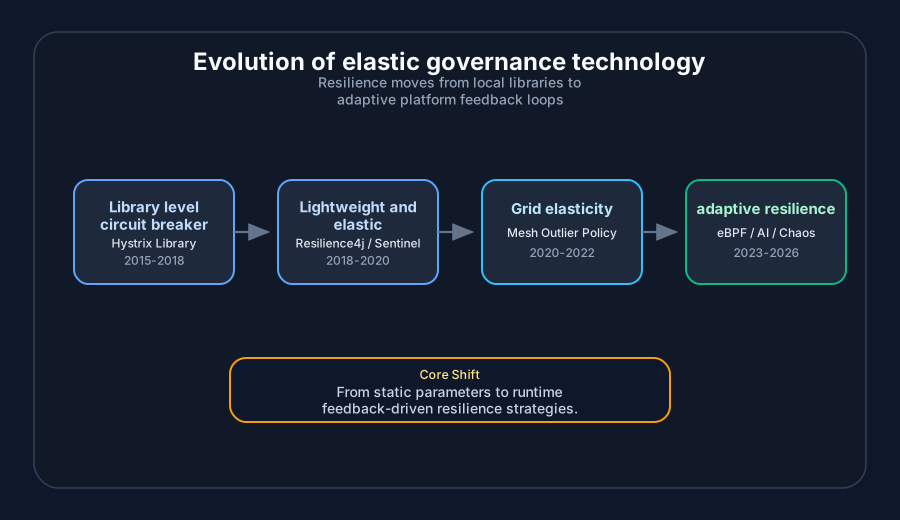
Figure 2: Evolution of elastic governance technology (library-level circuit breaker, lightweight elasticity, grid elasticity and adaptive resilience)
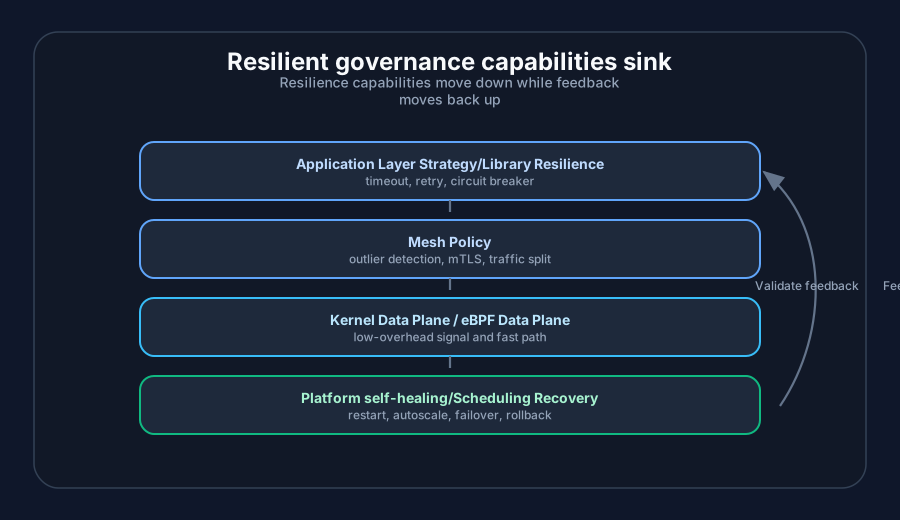
Figure 3: Elastic governance layer sinking (application strategy, grid strategy, kernel data plane, platform self-healing and verification closed loop)
About the author
Milome has more than ten years of experience in enterprise-level architecture design. He has served as a senior architect for enterprise-level CF platforms and has led the architecture design and implementation of multiple large-scale microservice platforms. Currently focusing on the research and practice of cloud native technology architecture and governance system.
Recommended Reading
Other articles in this series:
- From enterprise-level CF platform to cloud native (1): Architect’s review - the gains and losses of microservice governance in the era of enterprise-level CF platform
- From enterprise-level CF platform to cloud native (2): Observability-driven governance—from large monitoring screens to precise decision-making systems
- From enterprise-level CF platform to cloud native (3): The evolution of traffic governance - from Spring Cloud Gateway to Gateway API and Ambient Mesh
- From enterprise-level CF platform to cloud native (5): The evolution of release governance—from manual approval to progressive delivery
- From enterprise-level CF platform to cloud native (6): Summary—an architect’s perspective on enterprise-level microservices governance
References
- Michael T. Nygard. “Release It! Design and Deploy Production-Ready Software” (2nd Edition), Pragmatic Bookshelf, 2018.
- Ben Christensen. “Fault Tolerance in a High Volume, Distributed System”, Netflix Tech Blog, 2012.
- Netflix. “Chaos Engineering: Building Confidence in System Behavior through Experiments”, O’Reilly Media, 2017.
- Betsy Beyer et al. “Site Reliability Engineering: How Google Runs Production Systems”, O’Reilly Media, 2016.
- Resilience4j Documentation. https://resilience4j.readme.io/
- Sentinel Documentation. https://sentinelguard.io/
- Istio Documentation. https://istio.io/latest/docs/
Series context
You are reading: From enterprise-level CF platform to cloud native: more than ten years of evolution of enterprise-level microservice governance
This is article 4 of 6. Reading progress is stored only in this browser so the full series page can resume from the right entry.
Series Path
Current series chapters
Chapter clicks store reading progress only in this browser so the series page can resume from the right entry.
- From enterprise-level CF platform to cloud native (1): Architect's review - the gains and losses of microservice governance in the era of enterprise-level CF platform Based on the front-line architecture practice of enterprise-level CF platforms from 2015 to 2020 and industry observations from 2015 to 2026 (to date), we review the microservice governance design decisions in the Cloud Foundry era and analyze which ones have withstood the test of time and which ones have been reconstructed by the cloud native wave.
- From enterprise-level CF platform to cloud native (2): Observability-driven governance—from monitoring large screens to precise decision-making systems With 6 years of practical experience as an enterprise-level platform architect, we analyze the core position of observability in microservice governance, from data islands to OpenTelemetry unified standards, and build a governance system for accurate decision-making.
- From enterprise-level CF platform to cloud native (3): The evolution of traffic management - from Spring Cloud Gateway to Gateway API and Ambient Mesh Review the practice of Spring Cloud Gateway in the enterprise-level CF platform, analyze the standardization value of Kubernetes Gateway API, explore the evolution logic from Service Mesh to Ambient Mesh, and provide a decision-making framework for enterprise traffic management selection.
- From enterprise-level CF platform to cloud native (4): Redefining elastic fault tolerance—from Hystrix to adaptive governance Review Hystrix's historical position in microservice elastic governance, analyze Resilience4j's lightweight design philosophy, explore new paradigms of adaptive fault tolerance and chaos engineering, and provide practical guidance for enterprises to build resilient systems.
- From enterprise-level CF platform to cloud native (5): The evolution of release governance—from manual approval to progressive delivery Review the manual approval model of traditional release governance, analyze the evolution of blue-green deployment and canary release, explore the new paradigm of GitOps and progressive delivery, and provide practical guidance for enterprises to build an efficient and secure release system.
- From enterprise-level CF platform to cloud native (6): Summary—an architect’s perspective on enterprise-level microservice governance Review the evolution of microservice governance over the past ten years from 2015 to 2026 (to date), refine the first principles of architects, summarize the implementation paths and common pitfalls of enterprise-level governance, look forward to future trends, and provide a systematic thinking framework for technical decision-makers.
Reading path
Continue along this topic path
Follow the recommended order for Microservice governance instead of jumping through random articles in the same topic.
Next step
Go deeper into this topic
If this article is useful, continue from the topic page or subscribe to follow later updates.
Loading comments...
Comments and discussion
Sign in with GitHub to join the discussion. Comments are synced to GitHub Discussions