Series · Java
Java Core Technologies Deep Dive
Build a modern Java architecture decision framework from JMM, GC, Loom, Valhalla, Panama, cloud-native deployment, and Spring AI.
Progress is stored in this browser only; without saved progress, reading starts from chapter one.
- Status
- Completed
- Difficulty
- Advanced
- Chapters
- 8/8
- Read time
- 320 min
Guide
Series guide
Understand the reading promise, main path, and reference chapters before entering individual articles.
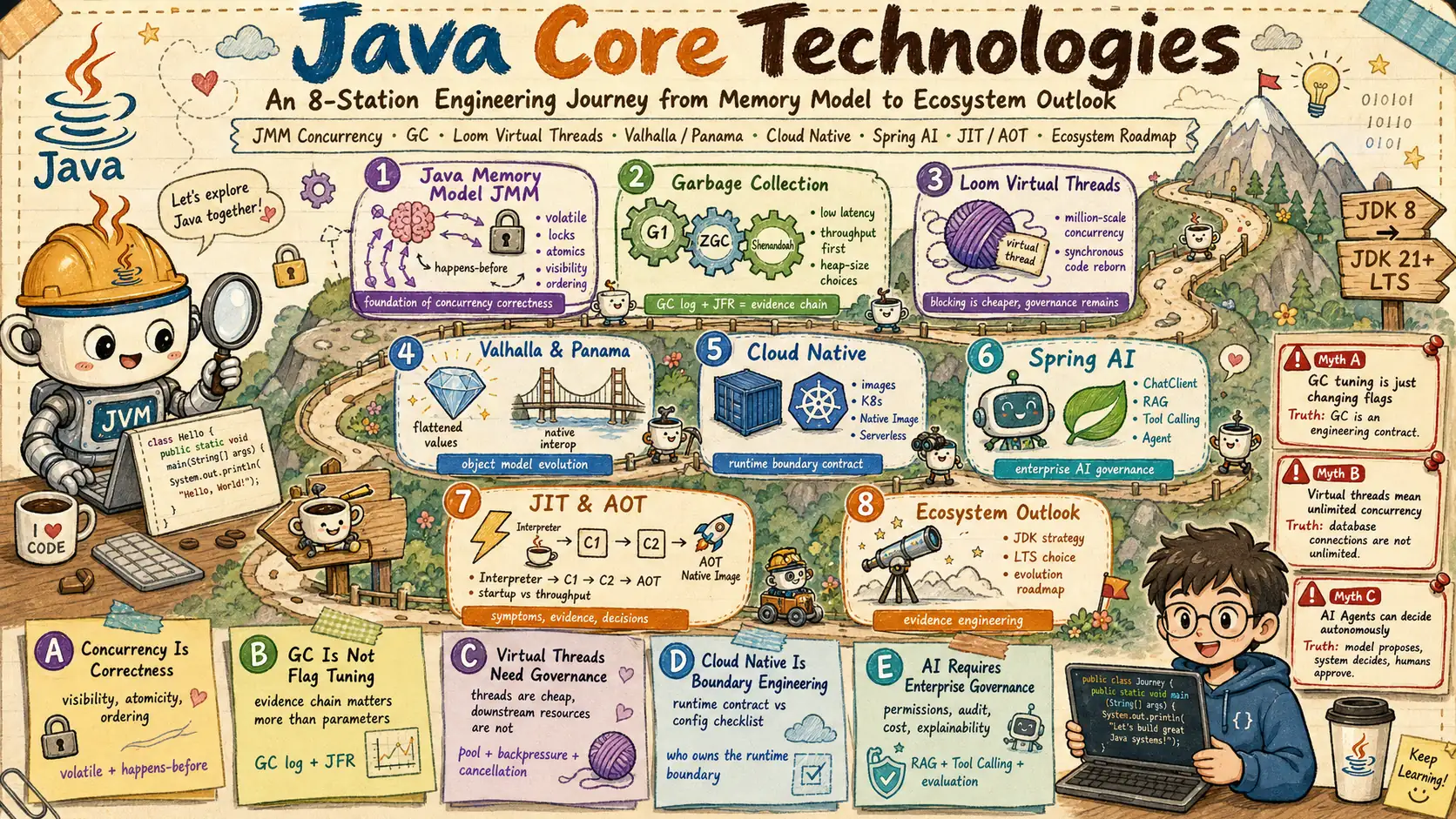
This series is written for Java engineers and architects who already have production experience. It does not try to list every API. Instead, it builds a decision path from JVM fundamentals, concurrency, garbage collection, compilation, cloud-native deployment, and enterprise AI integration.
Series Articles
- Java Memory Model Deep Dive — Understand happens-before,
volatile,finalfields, and safe publication. - Modern Java Garbage Collection — Use version boundaries to reason about G1, ZGC, Shenandoah, and production tuning.
- Project Loom Engineering Boundaries — Separate virtual threads, pinning, structured concurrency, and resource governance.
- Valhalla and Panama — Separate the delivered FFM API from value type designs that are still evolving.
- JPMS and Cloud-Native Deployment — From jlink to Native Image, identify production image risks.
- Spring AI and LangChain4j — Separate official APIs, sample wrappers, and enterprise AI operating boundaries.
- JIT and AOT Compilation Strategy — Use evidence to choose C2, Graal, JFR, JITWatch, and Native Image.
- Java Ecosystem Outlook — Plan upgrades with JDK 25 LTS, JDK 26 GA, and JDK 27 EA as the baseline.
Version Baseline
The verification date for this series is 2026-05-14. The version baseline is JDK 26 GA, JDK 25 LTS, and JDK 27 EA. Preview, Incubator, Proposal / Draft, and EA-only content is labeled by status and is not presented as current production-ready Java.
Target Readers
- Senior Java engineers who need defensible answers about JVM, GC, concurrency, and performance.
- Architects responsible for JDK upgrades, cloud-native deployment, or Native Image evaluation.
- Technical leads integrating Java services into enterprise AI applications.
Series Path
Read by chapter
Chapter clicks store reading progress only in this browser so the series page can resume from the right entry.
- Java Memory Model Deep Dive: From Happens-Before to Safe Publication A production-grade deep dive into JMM, happens-before, volatile, final fields, optimistic locking, memory barriers, cache coherence, lock semantics, HotSpot implementation, and concurrency diagnostics.
- Modern Java Garbage Collection: Production Judgment, Evidence Collection, and Tuning Paths Use symptoms, GC logs, JFR, container memory, and rollback discipline to choose and tune G1, ZGC, Shenandoah, Parallel GC, and Serial GC without cargo-cult flags.
- Concurrency Governance with Virtual Threads in Production Systems Understand throughput, blocking, resource pools, downstream protection, pinning, structured concurrency, observability, and migration boundaries for Project Loom.
- Valhalla and Panama: Java's Future Memory and Foreign-Interface Model Separate delivered FFM API capabilities from evolving Valhalla value-type work, and reason about object layout, data locality, native interop, safety boundaries, and migration governance.
- Java Cloud-Native Production Guide: Runtime Images, Kubernetes, Native Image, Serverless, Supply Chain, and Rollback A production-oriented Java cloud-native guide covering runtime selection, container resources, Kubernetes contracts, Native Image boundaries, Serverless, supply chain evidence, diagnostics, governance, and rollback.
- Spring AI and LangChain4j: Enterprise Java AI Applications and AI Agent Architecture A production-grade guide to Spring AI, LangChain4j, RAG, tool calling, memory, governance, observability, reliability, security, and enterprise AI operating boundaries.
- JIT and AOT: From Symptoms to Diagnosis to Optimization Decisions A production decision guide for HotSpot, Graal, Native Image, PGO, and JVM diagnostics.
- Java Ecosystem Outlook: JDK 25 LTS, JDK 26 GA, and JDK 27 EA An enterprise architecture view of Java's next decade: version strategy, roadmap status, ecosystem boundaries, cloud-native operations, AI governance, and performance evolution.