Article
Future Outlook: Evolutionary Trends and Long-term Thinking of AI Programming Assessment
As the final article in the series, this article reconstructs the future route of AI Coding Mentor from the perspective of engineering decision-making: how evaluation objects evolve, how organizational capabilities are layered, and how governance boundaries are advanced.
Copyright Statement and Disclaimer This article conducts a comprehensive analysis based on public data such as SWE-bench, LiveCodeBench, OpenAI, Anthropic, and LangChain. The copyright of the original text belongs to the original author and original institution.
Original Nature The stage division, organizational structure and governance framework of this article are original reconstructions by the author and do not constitute a deterministic prediction of the future.
Beginning: What should I answer in the final chapter?
The previous eight articles have already laid out the methods and systems: from “Why do you want to do Coding Mentor”, to assessment methods, question design, collaboration agreements, case reviews, to data closed loop and SFT sample projects. The final chapter no longer repeats the tool list, but answers a more critical question:
As model capabilities continue to improve, tool chains continue to be automated, and organizational divisions of labor continue to change, how can teams avoid treating today’s processes as tomorrow’s upper limit?
What this article gives is not “what will definitely happen next year”, but a set of executable long-term judgment framework:
- What changes have already occurred in 2026 cannot be evaluated according to the old logic.
- What should the next stage evaluation system look like to support real project delivery?
- How to reconstruct the boundaries of responsibilities between humans and AI so that governance capabilities are not lost when efficiency is improved.
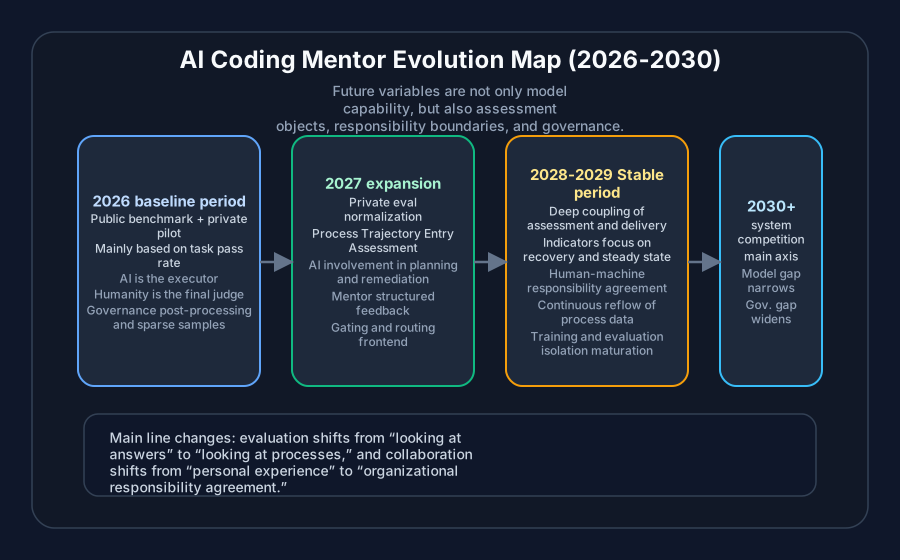
1. First, let’s take a look at the changes that have already taken place in 2026
Before discussing the future, we must first gather the consensus on what has “changed”. Otherwise, the so-called future outlook will only degenerate into subjective preferences.
Change 1: Public benchmarks moved back from “Main evaluation by” to “Entry filter”
HumanEval, SWE-bench, and LiveCodeBench are still valuable, but in corporate practice, they are becoming more and more like “capability threshold judgments” rather than “online decision-making basis.”
| use | still valid | Obviously insufficient |
|---|---|---|
| Model initial screening | Determine whether to enter the available range | Unable to override team private constraints |
| Universal comparison | Observe the general ability level | Difficult to reflect real business boundaries |
| research exchange | Provide a unified discussion context | Easily overfitted by specific strategies |
The organizational-level conclusion is straightforward: public scores no longer directly answer “whether this model can be delivered stably in the organization’s production chain.”
Change 2: The evaluation object shifts from “single output” to “process trace”
In the past, evaluation was more about the final answer; now more important is the quality of the process: how the model retrieves context, how it proposes a plan, how it handles failure, how it is repaired and verified.
Without trajectory data, the team had little ability to answer three core questions:
- Does the failure come from model capabilities or from insufficient context supply?
- Does the improvement come from prompts, tool chains, or data feedback?
- Why do similar errors appear repeatedly and why are they not absorbed by the system?
Change 3: Data governance changes from “post-compliance” to “front-end architecture”
Once the data enters evaluation or training, it affects the next round of model behavior. Governance is no longer about auditing before going online, but about gating actions before samples enter the system.
The most typical front-end governance issues include:
- The training set is isolated from the evaluation set.
- Desensitization and blocking of sensitive information.
- Sample removal mechanism for outdated rules.
- Annotation of the applicable range of preference samples.
This is why articles 7 and 8 emphasize closing the loop and gating first, and then talking about the scale of training.
2. The evolution in the next three years will not be a “stronger model”, but a “stronger system”
Many teams’ default imagination of the future is that models will be stronger and problems will automatically disappear. The engineering reality is often the opposite: the stronger the model, the higher the organization’s requirements for system capabilities.
Three axes of evolution can be used to understand the direction of change from 2026 to 2029.
| Evolution axis | 2026 Focus | 2027-2029 Key Shifts |
|---|---|---|
| Evaluation axis | Task pass rate and defect rate | Process quality, resilience, long-term stability |
| collaboration axis | Manual review | Responsibility stratification and human-machine collaboration protocol |
| data axis | Record collaboration log | Routing, gating, versioning and lifecycle management |
These three axes jointly point to one judgment: the future competition will not be “who can use AI”, but “who can stably operate the AI collaboration system”.
3. Next-generation evaluation system: four-layer architecture instead of a single test platform
If you only understand the evaluation system from the “evaluation script”, you will eventually get a set of score reports. What organizations really need is a system architecture that can deliver back.
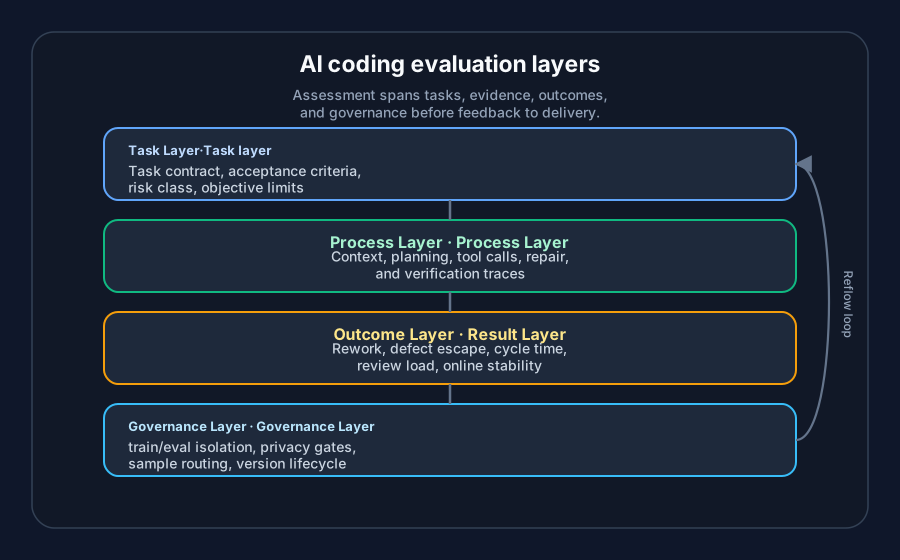
For project implementation, the next-generation evaluation system can be split into four layers.
1) Task Layer
Define task contracts, boundary conditions, non-goals, and acceptance criteria. The purpose is to ensure that “the correct question is assessed” rather than a randomly constructed alternative question.
2) Process Layer
Collect trace evidence: context retrieval, planning, tool invocation, failure repair, and verification actions. The function is to allow the team to attribute “why success/failure” and form reusable improvement signals.
3) Outcome Layer
Measure delivery results: functional correctness, rework rate, defect escape, performance impact, review burden. The effect is to align assessments with real business results, rather than just looking at offline scores.
4) Governance Layer
Perform data routing and boundary control: train/eval isolation, sensitive data blocking, and sample life cycle management. The function is to prevent the systematic deviation of “increased indicators but illusion of ability”.
The minimum set of indicators corresponding to the four layers can be defined as follows:
| Hierarchy | minimum indicator | for decision making |
|---|---|---|
| task layer | Contract completeness rate, acceptance reproducibility rate | Whether the task can enter automated evaluation |
| process layer | Traceability rate, recurrence rate of similar errors | Can the problem be absorbed by the system? |
| result layer | Rework rate, escaped defect rate, delivery cycle | Does AI participation truly create value? |
| Governance | Sample gating pass rate, isolation violation rate | Is the data safe to enter for training/evaluation? |
4. The future of the human-machine relationship is not about “who replaces whom” but “who bears what responsibilities”
“Will AI replace developers?” is a hot topic of discussion, but it is of limited help to organizational practice. The real enforceable question is who bears which type of responsibility for tasks with different levels of risk.
| Responsibility type | Developer | Coding Mentor | Platform/Governance Role | AI model |
|---|---|---|---|---|
| task definition | Main responsibility | Build standards together | Provide templates | Auxiliary clarification |
| Solution generation | Review and choice | set boundaries | Guarantee process can be traced | Generate candidates |
| Quality verification | Perform verification | Definition rubric | Automated gate control | Provide evidence of self-examination |
| Risk control | Uncover business risks | Determine whether to release | Implement blocking rules | Expose uncertainties |
| Knowledge accumulation | Submit factual record | structured feedback | Data routing and versioning | Trained and evaluated objects |
This table has a core signal: AI can become increasingly involved in execution, but responsibility does not automatically transfer to AI. Responsibility only moves from “personal experience” to “organizational systems.”
5. The key to future decision-making is not “whether to use AI or not”, but “when to expand which layer”
Most organizations are no longer discussing “whether to use AI programming”, but “where to invest resources next.” To avoid blind expansion, decisions can be broken down into three categories.
Decision A: Expand model capabilities
Applicable conditions:
- Private eval has been stabilized and the main bottleneck is model capability boundaries.
- Similar tasks continue to fail in the same context.
Not applicable:
- The task contract is confusing, the verification link is incomplete, and the feedback cannot be reused.
Decision B: Expand the project process
Applicable conditions:
- The model capability is available, but the burden of rework and review is high.
- The problem lies mainly in process breakpoints (missing context, missing validation, unclear routing).
Not applicable:
- The tasks themselves are unstable, with requirements boundaries changing frequently and ungoverned.
Decision C: Expand training data
Applicable conditions:
- High-quality Mentor signaling and gating mechanisms already exist.
- The train/eval isolation is clear and the source of the sample can be traced.
Not applicable:
- Logs and samples are not stratified, and governance rules are unstable.
Corresponding decision-making sequence suggestions:
- First improve the process and governance, and then expand the scale of training.
- Fill in the private eval first, and then do model replacement or fine-tuning comparison.
- Improve the sample hardness first, and then pursue the sample quantity.
6. Long-term risks: The most dangerous thing is not “model weakening” but “system deformation”
The most common failure in the next few years will not necessarily be model degradation, but the gradual deformation of organizational systems under high-pressure delivery.
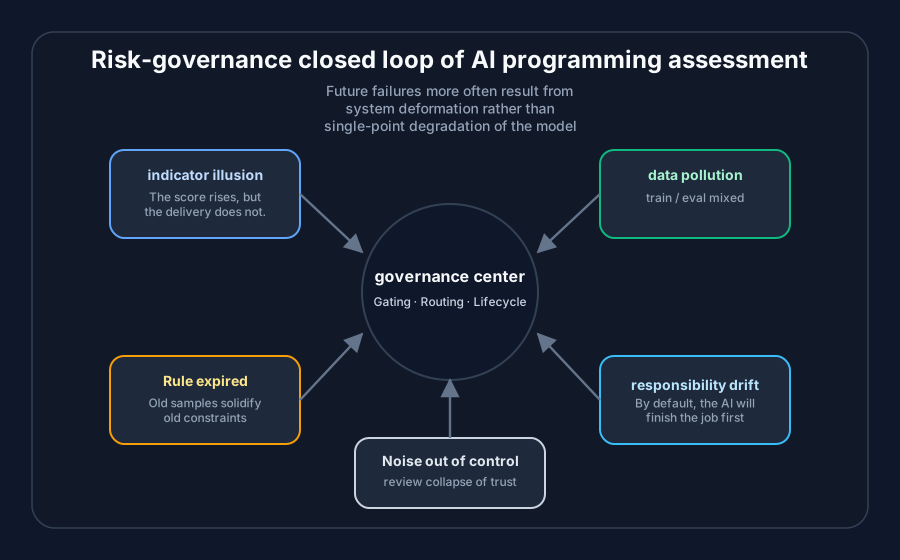
It is recommended to focus on five types of system risks:
| risk | Typical performance | governance actions |
|---|---|---|
| indicator illusion | Offline scores increase, but online rework does not decrease | Forced linkage between online indicators and offline indicators |
| data pollution | Mixing train/eval results in falsely high regression results | Data isolation, version audit, random inspection |
| Rule expired | Historical samples solidify old architectural constraints | Life cycle management and regular removal |
| responsibility drift | The default is to let the AI “finish it first and then talk about it” | Risk classification and responsibility matrix pre-positioning |
| Noise out of control | review A large number of invalid comments, trust collapsed | Severity stratification and effectiveness feedback |
In other words, the long-term competition is not “whose AI is smarter” but “whose system is less prone to distortion.”
7. Closing Suggestion: Turn future judgments into current actions
If this conclusion only leaves “trend judgment”, its value will be very limited. A more practical approach is to break the trend into check items that can be executed during the current quarter.
It is recommended that each team self-check at least the following seven items:
- Whether the private eval covers the core task and not just the public baseline.
- Whether AI collaboration retains traceability traces by default, rather than just the final code.
- Is human feedback structured into error types and correction principles, rather than subjective comments?
- Whether data routing clearly differentiates between eval, training candidates, knowledge base, and drop zones.
- Whether train/eval has strong isolation and versioned auditing.
- Does the sample have life cycle management that can handle expiration rules and outdated structures?
- Does the organization have a clear human-machine responsibility matrix, rather than relying on individual experts to provide the answers?
Conclusion: The future does not “arrive automatically” but is “engineered and constructed”
From the 1st to the 9th article in this series, this series essentially only does one thing: splitting “the ability to use AI” into the organizational capabilities of “being able to evaluate, feedback, govern, and iterate.”
If you compress this main line into one sentence, it would be:
Only by structuring human engineering judgment can AI collaboration capabilities be scaled up; by systematizing evaluation and governance first, can training and automation not deviate from the goal.
The future will not automatically be better just because the model is stronger. What really determines the upper limit is still how the team defines the problem, how to manage feedback, how to guard the boundaries, and how to precipitate delivery after delivery into long-term capabilities.
References and Acknowledgments
- SWE-bench — Princeton/UCB
- LiveCodeBench — UCB/MIT/Cornell
- OpenAI Evals and enterprise evaluation practice
- Anthropic Agent Engineering Practice
- LangChain trajectory-driven improvement practice
Series context
You are reading: AI Coding Mentor Series
This is article 9 of 9. Reading progress is stored only in this browser so the full series page can resume from the right entry.
Series Path
Current series chapters
Chapter clicks store reading progress only in this browser so the series page can resume from the right entry.
- Why do you need to be a coding mentor for AI? When AI programming assistants become standard equipment, the real competitiveness is no longer whether they can use AI, but whether they can judge, calibrate and constrain the engineering output of AI. This article starts from trust gaps, feedback protocols, evaluation standards and closed-loop capabilities to establish the core framework of "Humans as Coding Mentors".
- Panorama of AI programming ability evaluation: from HumanEval to SWE-bench, the evolution and selection of benchmarks Public benchmarks are not a decoration for model rankings, but a measurement tool for understanding the boundaries of AI programming capabilities. This article starts from benchmarks such as HumanEval, APPS, CodeContests, SWE-bench, LiveCodeBench and Aider, and explains how to read the rankings, how to choose benchmarks, and how to convert public evaluations into the team's own Coding Mentor evaluation system.
- How to design high-quality programming questions: from question surface to evaluation contract High-quality programming questions are not longer prompts, but assessment contracts that can stably expose the boundaries of abilities. This article starts from Bloom level, difficulty calibration, task contract, test design and question bank management to explain how to build a reproducible question system for AI Coding Mentor.
- Four-step approach to AI capability assessment: from one test to continuous system evaluation Serving as a coding mentor for AI is not about doing a model evaluation, but establishing an evaluation operation system that can continuously expose the boundaries of capabilities, record failure evidence, drive special improvements, and support collaborative decision-making.
- Best Practices for Collaborating with AI: Task Agreement, Dialogue Control and Feedback Closed Loop The core skill of being a Coding Mentor for AI is not to write longer prompt words, but to design task protocols, control the rhythm of conversations, identify error patterns, and precipitate the collaboration process into verifiable and reusable feedback signals.
- Practical cases: feedback protocol, evaluation closed loop, code review and programming education data Case studies should not stop at “how to use AI tools better”. This article uses four engineering scenarios: model selection evaluation, feedback protocol design, code review signal precipitation, and programming education data closed loop to explain how humans can transform the AI collaboration process into evaluable, trainable, and reusable mentor signals.
- From delivery to training: How to turn AI programming collaboration into a Coding Mentor data closed loop The real organizational value of AI programming assistants is not just to increase delivery speed, but to precipitate trainable, evaluable, and reusable mentor signals in every requirement disassembly, code generation, review and revision, test verification, and online review. This article reconstructs the closed-loop framework of AI training, AI-assisted product engineering delivery, high-quality SFT data precipitation, and model evaluation.
- From engineering practice to training data: a systematic method for automatically generating SFT data in AI engineering Following the data closed loop in Part 7, this article focuses on how to process the screened engineering assets into high-quality SFT samples and connect them to a manageable, evaluable, and iterable training pipeline.
- Future Outlook: Evolutionary Trends and Long-term Thinking of AI Programming Assessment As the final article in the series, this article reconstructs the future route of AI Coding Mentor from the perspective of engineering decision-making: how evaluation objects evolve, how organizational capabilities are layered, and how governance boundaries are advanced.
Reading path
Continue along this topic path
Follow the recommended order for AI programming assessment instead of jumping through random articles in the same topic.
Next step
Go deeper into this topic
If this article is useful, continue from the topic page or subscribe to follow later updates.
Loading comments...
Comments and discussion
Sign in with GitHub to join the discussion. Comments are synced to GitHub Discussions