Article
Four-step approach to AI capability assessment: from one test to continuous system evaluation
Serving as a coding mentor for AI is not about doing a model evaluation, but establishing an evaluation operation system that can continuously expose the boundaries of capabilities, record failure evidence, drive special improvements, and support collaborative decision-making.
Copyright Statement and Disclaimer This article is based on benchmark testing methodologies such as HumanEval, SWE-bench, and LiveCodeBench, and is combined with model evaluation practices in the industry for a comprehensive interpretation. The copyright of the original text belongs to the respective authors and research institutions.
Original Nature The “four-step evaluation method” proposed in this article (baseline test, stress test, special improvement, continuous evaluation) is the author’s original framework based on theoretical research and engineering practice. This article is not a paragraph-by-paragraph translation, nor does it represent the views of the above-mentioned research institutions.
Beginning: Why assessment can’t be a one-off
When many teams introduce AI programming assistants, they will first conduct a centralized evaluation: select several types of tasks, run several sets of models, and compare the pass rate, code quality, and developer subjective experience. This action is necessary, but if the evaluation stops here, the conclusion will soon become invalid.
The reason is simple: AI programming capabilities are not static attributes, but the result of a combination of models, tasks, context, tool permissions, codebase status, and team feedback patterns. The model version will change, the code base will change, the team tasks will change, the prompt method will change, and the test set will be contaminated or overfitted. The boundaries of “trustworthy” tasks three months ago may have drifted three months later; problems that were not exposed at the time may also appear in new business scenarios.
One-time assessments are most likely to create two kinds of illusions. The first illusion is to overestimate stability: a model has a high pass rate on the baseline questions, so the team also gives it more complex cross-module changes. The second misunderstanding is underestimating the room for improvement: when a model fails in a stressful scenario, the team simply gives up without analyzing whether the failure is due to unclear topic, insufficient context, missing tool chain, or immature feedback protocol.
The evaluation goal of Coding Mentor is not to score AI once, but to continuously answer four questions: what tasks can it stably complete now, under what conditions will it fail, what interventions can the team use to improve the success rate, and whether the capability boundary is drifting.
These four questions correspond to a set of closed loop evaluation operations:
- Baseline testing: Establish a portrait of current capabilities.
- Stress testing: Identify reliable boundaries and high-risk areas.
- Specialized improvements: Adapt tasks, context, tools, and feedback protocols to failure modes.
- Continuous evaluation: Integrate evaluation into daily delivery and model change processes.
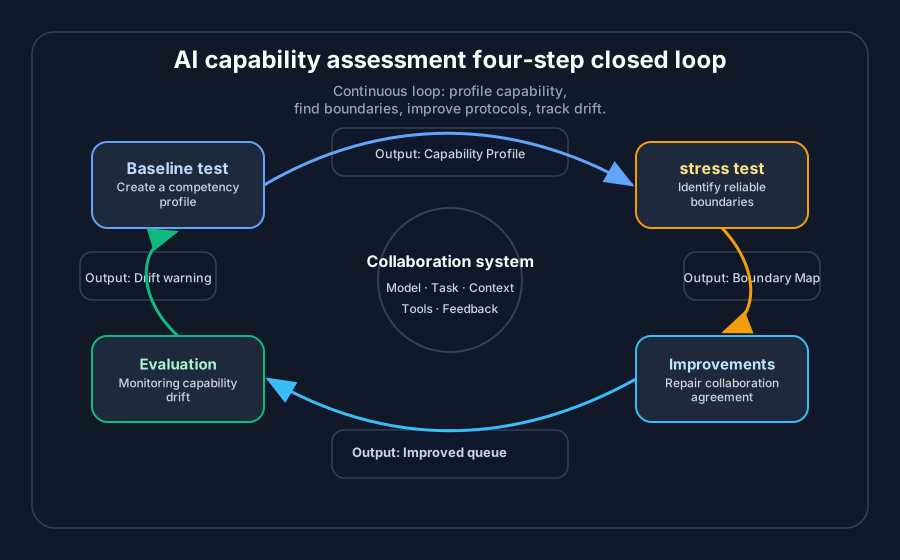
The object of evaluation is not the model itself, but the collaborative system
If you only ask “Is a certain model strong or not?” the evaluation can easily slide into ranking-based thinking. The ranking list is valuable, but it answers the general capability position and does not answer whether the team can use this model safely, stably, and economically in its own engineering flow.
A more accurate evaluation object should be a collaborative system of “model plus task plus context plus tool plus human feedback”. The same model performs very well with clear questions, complete tests, runnable tools, and structured feedback; if it is replaced with fuzzy requirements, fragmented context, no test feedback, and unstable engineering constraints, the performance may be completely different.
Therefore, the evaluation protocol should be fixed before the evaluation.
| Agreement elements | Issues that must be fixed | What happens if it is not fixed? |
|---|---|---|
| Model configuration | Model version, temperature, context length, output limit | The results are irreproducible |
| Task sample | Task source, difficulty, ability level, contamination risk | Pass rate cannot be explained |
| context budget | Which files, documents, error logs and historical PRs can be seen | Unable to compare model’s true understanding ability |
| Tool permissions | Whether to allow running tests, searching code, calling lint or type checking | Tool capabilities and model capabilities are mixed |
| feedback round | Whether to allow repair after failure, how many rounds of repair, and whether to provide error logs | Single round ability and collaborative ability mixed together |
| Scoring caliber | Automated testing, manual rubric, modification scope, risk level | Final conclusions can easily become subjective impressions |
This table determines whether a return to running can be evaluated. Without an agreement, the evaluation is just a demonstration; with an agreement, the evaluation results can be entered into historical comparison, model selection, delivery access, and subsequent training data precipitation.
Step One: Baseline Testing to Establish a Capability Portrait
Baseline testing is not to prove that the AI is strong, nor is it to find the best pass rate. Its function is to establish a repeatable capability reference line: under a fixed model configuration, a fixed task set, and a fixed scoring caliber, what types of programming tasks can AI currently complete.
Baseline tasks should be sampled from the team’s real work, not just from public algorithm problems. Open algorithm questions can cover syntax and algorithm capabilities, but it is difficult to represent the team’s framework, architectural constraints, exception handling specifications, testing habits, and code review standards. A valuable baseline set should usually contain five categories of tasks.
| Capability dimension | Task sample | Observation points |
|---|---|---|
| Language and framework capabilities | Language features, framework APIs, common library usage | Whether it is possible to write code that is runnable and conforms to version constraints |
| Business logic capabilities | Filtering and sorting, status transfer, permission verification, data conversion | Whether the task contract and boundary conditions can be adhered to |
| Code base understanding | Add new functions or modify behavior in existing modules | Whether to respect existing structure, naming and dependency boundaries |
| Debugging and repair capabilities | Fix issues based on failed tests, logs, or issues | Is it possible to locate the root rather than the surface patch? |
| Engineering judgment ability | Solution selection, migration strategy, reconstruction boundaries, risk description | Can constraint conflicts and unacceptable risks be explained? |
The key to a baseline test is not the more questions, the better, but the coverage and interpretability. Each question should have clear ability labels, difficulty labels, assessment budgets, and passing criteria. Otherwise, the pass rate can only show “how many of these questions have been passed”, but not “which engineering tasks this model is suitable for.”
Baseline results should also not be summarized into just one overall score. Total scores can mask structural differences. A model may be strong in single-file implementation, but weak in cross-module modification; it may perform stably on algorithmic questions, but overexert itself under vague requirements; it may have a high test pass rate, but the scope of modifications often crosses the boundary. Coding Mentor needs a profile of capabilities, not a list of champions.
The output of the baseline test includes at least four types of assets.
| output | use |
|---|---|
| ability portrait | Explain which tasks can be handed over to AI by default and which need to be led by humans |
| Task layering | Divide tasks into categories that can be automated, require review, and require human leadership |
| First draft of failure types | Document common errors such as interface mismatches, missing boundaries, and misreading tests |
| Evaluation Baseline Version | Serves as a comparison point for subsequent model versions, prompting protocols, and toolchain changes |
After the baseline test is completed, don’t rush to expand the scope of use. What is more important is to see whether the baseline exposes obviously unstable abilities. If the pass rate of a certain type of task is not high, but the team often needs it, it should enter the second step of stress testing instead of directly deciding whether it is available or not based on impressions.
Step 2: Stress test to find the boundaries of capabilities
The baseline test answers “how does it perform under normal conditions”, and the stress test answers “under what conditions will it fail”. For Coding Mentors, the latter issue is more important because real engineering risks often occur at the boundaries: requirements are incomplete, the context is too long, dependencies are complex, test feedback is ambiguous, and performance or security constraints are not written in a conspicuous place.
Stress testing is not about deliberately making things difficult for AI, but about systematically exposing risks. Common stress dimensions include four categories.
| Stress dimension | Supercharging method | Failures to watch |
|---|---|---|
| complexity pressure | From single function to multi-module, from single rule to multi-constraint combination | Problem decomposition failure, state consistency errors, and complexity out of control |
| contextual pressure | Increase code base size, dependency hierarchy, and history constraints | Modify wrong files, ignore existing abstractions, break public interfaces |
| ambiguity pressure | Reduce requirement completeness or add optional trade-offs | Failure to clarify requirements, incorrect default assumptions, and over-implementation |
| confrontational pressure | Design input and question areas for known template errors | Applying wrong patterns, ignoring boundaries, misunderstanding keywords |
The value of stress testing is not to make the model fail, but to turn the failure into a boundary map. The boundary map should tell the team: which tasks can be handed over to AI with low review costs, which tasks can be drafted by AI first but must be reviewed manually, and which tasks should not be directly handed over to AI for automatic completion.
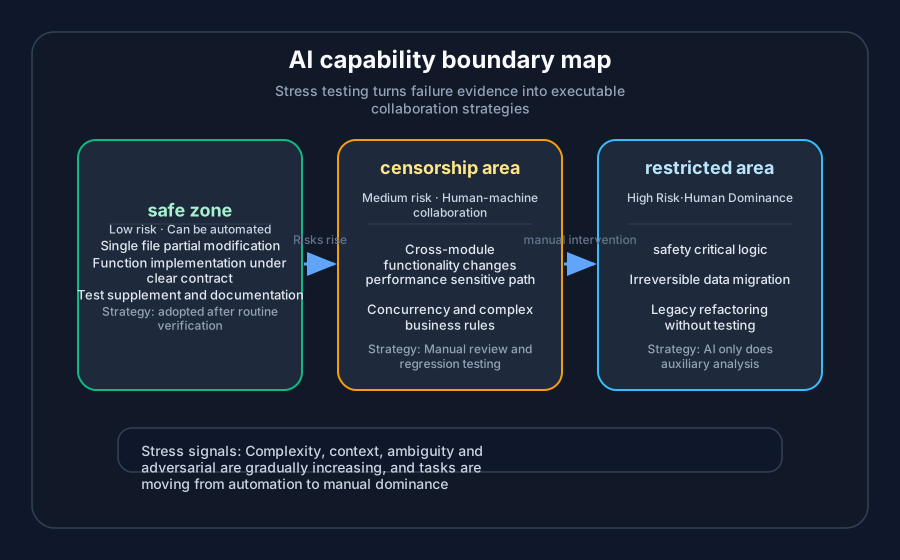
Boundary maps must contain at least three types of areas.
Safe zones are high-confidence tasks. For example, partial refactoring, single-function implementation under clear interfaces, common test supplements, simple log parsing, format conversion and low-risk document generation. Such tasks still require verification, but do not require intensive manual reasoning every time.
Review areas are collaborative tasks. For example, cross-module functions, performance-sensitive paths, complex business rules, asynchronous concurrency, database queries, permission verification, and production configuration changes. AI can be involved in planning, drafting, and partial implementation, but humans must review task boundaries, scope of modifications, test coverage, and risk descriptions.
No-go zones are high-risk missions. For example, safety-critical logic, irreversible data migration, compliance-sensitive processing, complex production accident handling, and reconstruction of legacy systems lacking testing. AI can help organize information, generate candidate solutions, or interpret code, but it cannot be the final executor.
After the stress test is completed, failure cases should be structured and recorded. There is no value in just recording “failed”. At least record which layer of contract was violated: task goal, interface contract, data constraints, behavioral constraints, test expectations, modification scope, and risk description. In this way, failure will become the input for the next step of special improvement.
The third step: special improvement, not memorizing templates, but repairing the collaboration agreement
Many teams understand special improvements as “writing better prompts”. This only solves a small part of the problem. Failures in AI programming are often not a single cue word problem, but a combined mismatch in task contract, context organization, tool feedback, example quality, and acceptance criteria.
“Training” here doesn’t necessarily mean fine-tuning the model. A more realistic approach for most teams is to first make special interventions in the collaboration system: change task descriptions, supplement contextual indexes, establish error type libraries, update test sets, adjust the order of tool calls, and solidify the code review rubric. Only when these signals are sufficiently stable, auditable, and reusable will the discussion proceed to SFT or preference data production.
Special improvements can be used to deduce intervention methods from failure types.
| Failure type | Common root causes | Priority intervention |
|---|---|---|
| Interface mismatch | The question does not have a stable signature or there are multiple similar interfaces in the context. | Supplement task contracts and interface constraints |
| Boundary omission | Examples only cover the main path, hidden tests lack explanation | Add boundary examples and failure labels |
| Modification range out of bounds | The model does not know which files cannot be changed | Add file ownership and change boundaries |
| performance degradation | There is no complexity budget for the question or insufficient stress testing | Increase performance use cases and complexity rubric |
| Requirements misunderstanding | Business terms are not defined and acceptance criteria are vague | Establish a glossary and acceptance agreement |
| New errors introduced after repair | Only failure logs are given, no regression verification is required | Post-curing repair verification checklist |
The way in which special improvements are evaluated should also be done with caution. You can’t just look at the performance improvement after the intervention, but look at whether similar tasks have steadily improved under a fixed assessment protocol. Otherwise, the team may just train the model to solve certain problems without improving the reliability of the real project.
An effective special improvement closed loop usually includes five steps: selecting failure types, extracting representative samples, designing intervention strategies, re-evaluating on the reserved set, and deciding whether to enter a long-term agreement. Representative samples were used for analysis and holdout sets were used for validation. The two cannot be mixed, otherwise the improvement will easily lead to overfitting.
The final output of special improvements is not a prompt, but a set of maintainable assets: task contract templates, error type libraries, rubrics, sample libraries, test patches, context routing rules and tool calling strategies. These assets will continue to play a role in the cases in Part 6 and the data loop in Part 7.
Step 4: Continuously evaluate and integrate evaluation into the engineering process
The goal of continuous evaluation is to allow the team to detect capability drift in a timely manner when the model, code base, or collaboration method changes. It’s not as simple as re-running a big test every once in a while, but putting evaluation into the daily delivery process.
Continuous assessment has at least three sources of data.
The first is a fixed evaluation set. It is used to compare changes in model versions, prompting protocols, toolchains, and context routing. The fixed assessment set must control the risk of contamination, and the questions, tests, and reference answers should not be disclosed at will. Each evaluation records the version, configuration, tool permissions, and evaluation budget.
The second item is real project feedback. It comes from PR, issues, code reviews, test failures, incident reviews and manual modification records. Real feedback can make up for the blind spots of fixed evaluation sets, but is also noisier and must be structured into error types, impact scope, repair costs, and reproducible evidence.
The third line is the online admission signal. It comes from mission-critical quality gatekeeping: tests passed, prohibited ranges modified, security or data boundaries violated, rollback options missing. Online access is not about blocking AI, but about deciding which tasks must add human review.
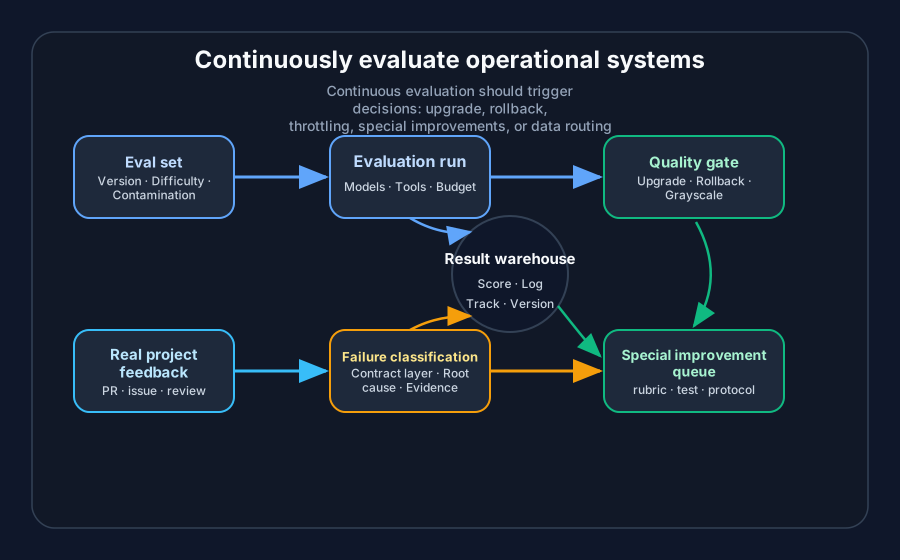
Continuous evaluation systems should avoid using only display dashboards. A truly useful dashboard should be able to trigger actions: when the pass rate of a certain type of task drops, whether to downgrade the scope of AI use; when a certain model version returns, whether to suspend upgrades; when a certain type of failure recurs, whether to enter special improvements; when the quality of feedback from certain real tasks is high enough, whether to enter the data closed loop discussed in Part 7.
Continuous assessment can be broken down into four rhythms.
| Rhythm | Trigger condition | Assessment focus | Typical decisions |
|---|---|---|---|
| Every model or tool upgrade | Model version, IDE plug-in, agent runtime changes | Whether regression and behavioral drift occur | Upgrade, rollback or grayscale |
| Weekly light return | Fixed small sample size, mission-critical types | Whether to destroy the core competency line | Early warning and task throttling |
| Review each iteration | Real PR, bug, rework records | Which failures go into the error type library | Update rubric and examples |
| Quarterly question bank calibration | Question bank pass rate deviates from target range | Difficulty, contamination risk, coverage gaps | Add new, offline or retitled items |
The difficulty with continuous evaluation is not the tools, but the organizational discipline. If no one maintains the evaluation set, the evaluation will become invalid; if no one marks the failure type, feedback will be lost; if no one turns the evaluation conclusions into usage strategies, the dashboard will just become a picture on the wall.
How to implement the four-step method in the first three months
Don’t try to build a complete platform in the first month, run through the evaluation agreement first. Select the three to five most common types of tasks for the team, prepare a small number of representative samples for each type, and fix the model configuration, context budget, tool permissions, and scoring caliber. The goal at this stage is to obtain the first version of the ability portrait, rather than pursuing the size of the question bank.
The second month entered stress testing and special improvements. Based on the failure types in the first month, select high-frequency and high-value issues for in-depth exploration. For example, boundary conditions are often missing, so boundary samples and rubrics are added; cross-module modifications often cross the boundary, so file ownership and change scope constraints are added; debugging tasks often only fix superficial symptoms, so root cause evidence and regression verification are required.
In the third month, start integrating the assessment into your daily process. Fixed regressions are run before model upgrades, key PRs record AI participation methods, code review comments are entered into the error type library, and rework costs and failure distribution are summarized after the project iteration. Only at this stage does the evaluation move from a test to an operational mechanism.
After three months, the team should be able to answer four questions: Which tasks can be handed over to AI at low cost, which tasks must remain in human review, which failures are being specifically improved, and which real-world collaboration data is eligible to enter the subsequent training or evaluation closed loop.
Common anti-patterns
The first anti-pattern is to only look at the overall pass rate. Overall pass rates can mask structural risks. A model scoring high on the Easy task does not mean it can handle cross-module modifications; a model falling behind on algorithm questions does not mean it is incapable of document generation, test supplementation, or log analysis.
The second anti-pattern is to write stress tests in a difficult way. The goal of stress testing is to find boundaries, not to create failures. Each stress scenario should correspond to real engineering risks, otherwise failure results cannot guide collaborative strategies.
The third anti-pattern is to equate ad hoc improvements with prompt optimizations. Prompt can be a consumption method, but it is not the asset itself. Long-term stable are task contracts, error types, example libraries, rubrics, testing and verification mechanisms.
The fourth anti-pattern is letting real feedback stay in chat transcripts and PR comments. Without structured data routing, real project feedback cannot enter the evaluation set, training candidate samples, or knowledge base.
The fifth anti-pattern is a disconnect between assessment and delivery. No matter how complete the evaluation report is, if it cannot affect model selection, task allocation, code review intensity, and online access control, it will not change the quality of the project.
Conclusion: Assessment is the control surface of collaborative systems
AI programming capability assessment is not a one-time acceptance, but the control surface of the human-machine collaboration system. Baseline testing allows the team to know the current capabilities, stress testing allows the team to see boundaries, dedicated improvements allow failures to enter the repairable process, and continuous evaluation prevents capability drift from being suddenly exposed in production.
When the evaluation mechanism is stable enough, the team’s trust in the AI no longer comes from feelings, but from evidence of repeatability. Which tasks can be let go, which tasks need to be reviewed, and which tasks must be manually led, can all be supported by the evaluation results.
This is also one of the core responsibilities of Coding Mentor: not to write more prompt words for AI, but to establish an engineering system that can continuously observe, calibrate, constrain and improve AI programming behavior.
References and Acknowledgments
- HumanEval — OpenAI
- SWE-bench — Princeton/UCB
- LiveCodeBench — UCB/MIT/Cornell
Series context
You are reading: AI Coding Mentor Series
This is article 4 of 9. Reading progress is stored only in this browser so the full series page can resume from the right entry.
Series Path
Current series chapters
Chapter clicks store reading progress only in this browser so the series page can resume from the right entry.
- Why do you need to be a coding mentor for AI? When AI programming assistants become standard equipment, the real competitiveness is no longer whether they can use AI, but whether they can judge, calibrate and constrain the engineering output of AI. This article starts from trust gaps, feedback protocols, evaluation standards and closed-loop capabilities to establish the core framework of "Humans as Coding Mentors".
- Panorama of AI programming ability evaluation: from HumanEval to SWE-bench, the evolution and selection of benchmarks Public benchmarks are not a decoration for model rankings, but a measurement tool for understanding the boundaries of AI programming capabilities. This article starts from benchmarks such as HumanEval, APPS, CodeContests, SWE-bench, LiveCodeBench and Aider, and explains how to read the rankings, how to choose benchmarks, and how to convert public evaluations into the team's own Coding Mentor evaluation system.
- How to design high-quality programming questions: from question surface to evaluation contract High-quality programming questions are not longer prompts, but assessment contracts that can stably expose the boundaries of abilities. This article starts from Bloom level, difficulty calibration, task contract, test design and question bank management to explain how to build a reproducible question system for AI Coding Mentor.
- Four-step approach to AI capability assessment: from one test to continuous system evaluation Serving as a coding mentor for AI is not about doing a model evaluation, but establishing an evaluation operation system that can continuously expose the boundaries of capabilities, record failure evidence, drive special improvements, and support collaborative decision-making.
- Best Practices for Collaborating with AI: Task Agreement, Dialogue Control and Feedback Closed Loop The core skill of being a Coding Mentor for AI is not to write longer prompt words, but to design task protocols, control the rhythm of conversations, identify error patterns, and precipitate the collaboration process into verifiable and reusable feedback signals.
- Practical cases: feedback protocol, evaluation closed loop, code review and programming education data Case studies should not stop at “how to use AI tools better”. This article uses four engineering scenarios: model selection evaluation, feedback protocol design, code review signal precipitation, and programming education data closed loop to explain how humans can transform the AI collaboration process into evaluable, trainable, and reusable mentor signals.
- From delivery to training: How to turn AI programming collaboration into a Coding Mentor data closed loop The real organizational value of AI programming assistants is not just to increase delivery speed, but to precipitate trainable, evaluable, and reusable mentor signals in every requirement disassembly, code generation, review and revision, test verification, and online review. This article reconstructs the closed-loop framework of AI training, AI-assisted product engineering delivery, high-quality SFT data precipitation, and model evaluation.
- From engineering practice to training data: a systematic method for automatically generating SFT data in AI engineering Following the data closed loop in Part 7, this article focuses on how to process the screened engineering assets into high-quality SFT samples and connect them to a manageable, evaluable, and iterable training pipeline.
- Future Outlook: Evolutionary Trends and Long-term Thinking of AI Programming Assessment As the final article in the series, this article reconstructs the future route of AI Coding Mentor from the perspective of engineering decision-making: how evaluation objects evolve, how organizational capabilities are layered, and how governance boundaries are advanced.
Reading path
Continue along this topic path
Follow the recommended order for AI programming assessment instead of jumping through random articles in the same topic.
Next step
Go deeper into this topic
If this article is useful, continue from the topic page or subscribe to follow later updates.
Loading comments...
Comments and discussion
Sign in with GitHub to join the discussion. Comments are synced to GitHub Discussions