Article
Why do you need to be a coding mentor for AI?
When AI programming assistants become standard equipment, the real competitiveness is no longer whether they can use AI, but whether they can judge, calibrate and constrain the engineering output of AI. This article starts from trust gaps, feedback protocols, evaluation standards and closed-loop capabilities to establish the core framework of "Humans as Coding Mentors".
Copyright Statement and Disclaimer This article provides a comprehensive interpretation based on multiple AI programming evaluation studies such as HumanEval, SWE-bench, and LiveCodeBench. The copyright of the original text belongs to the respective authors and research institutions.
Statement of Attribution of Opinions The “Coding Mentor” framework, capability assessment method and reverse collaboration perspective proposed in this article are the author’s original views, based on the analysis and reconstruction of existing research and engineering practice.
Original reference
- HumanEval — OpenAI: https://github.com/openai/human-eval
- SWE-bench — Princeton/UCB: https://www.swebench.com/
- LiveCodeBench — UCB/MIT/Cornell: https://livecodebench.github.io/
Original Nature This article is not a paragraph-by-paragraph translation, but a framework reconstruction and methodological refinement based on the reverse perspective of “human beings serve as mentors to AI”.
Question: Code that looks correct, why can’t it still be trusted directly?
AI programming assistants have gone from novel tools to everyday infrastructure. Writing functions, supplementing tests, interpreting error reports, generating API documents, and reconstructing local modules can all be handed over to AI for drafting. The question has also changed: in the past, the core question was “Can AI write code?” Now the core question is “Can you judge whether the code written by AI is trustworthy?”
A common scenario is this: you ask AI to help you implement the login status refresh logic, and it quickly provides the code with clear naming, complete comments, and the test can also run. A few days later, occasional session loss occurred online in high concurrency scenarios. The troubleshooting result was not a syntax error or an obvious omission of a logical branch, but a tiny race window between token verification and session update.
The most dangerous thing about this kind of problem is that it is hidden in “professional-looking” code.
AI makes code generation cheaper, but it does not automatically reduce the cost of engineering judgment. On the contrary, it shifts part of the judgment pressure from “how to write” to “can it be believed?” If the team does not have task contracts, boundary use cases, error classification and review mechanisms, the smoother the AI output, the more hidden the risk of misjudgment.
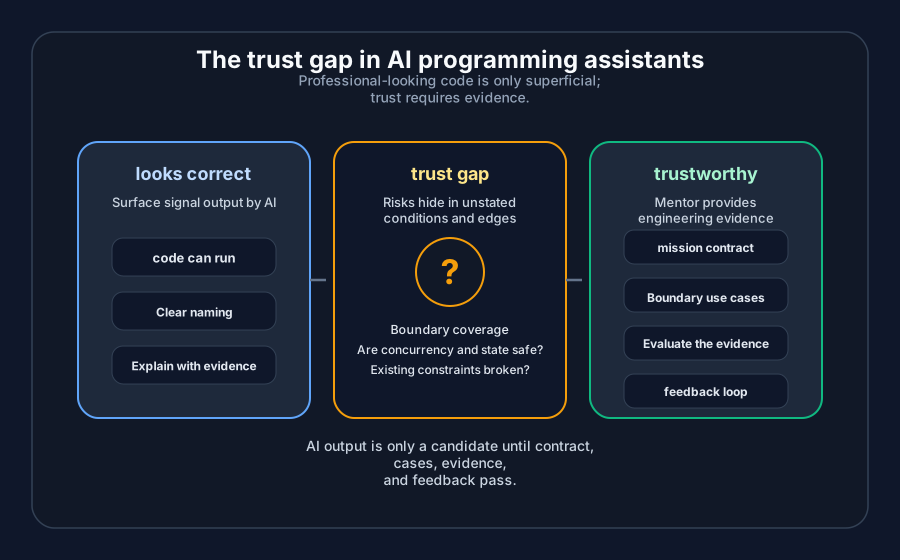
This is the starting point for this series: using AI is not a core competency, judging AI is. AI can generate answers, but it can’t take on the engineering responsibilities for you. What really determines the quality of collaboration is whether people can dismantle the vague sense of trust into an evaluable, feedbackable, and verifiable system.
Why are three common uses not enough?
When facing AI programming assistants, many developers will naturally adopt three perspectives: treating it as a tool, as a collaborator, or as an evaluated object on the model ranking list. These three perspectives are not wrong, but if you stop here, it is easy to form a one-way dependence.
| perspective | Common practice | short term gain | key limitations |
|---|---|---|---|
| tool perspective | Treat AI as an upgraded version of search engine, put forward requirements and copy the output | Get a quick draft | Only consume results without establishing judgment standards |
| Collaborator’s perspective | Treat AI as a pairing partner, it generates plans and people review them | Increase starting speed | Review itself requires systematic ability |
| Evaluator’s Perspective | Follow public scores such as HumanEval, SWE-bench, LiveCodeBench, Aider leaderboard, etc. | Quickly understand the approximate ability level of the model | Public scores cannot replace team private task evaluations |
The biggest problem with the tool perspective is passivity. You ask a question, the AI gives an answer, and you decide whether to accept it. This process seemed efficient, but it didn’t produce any reusable assets. The next time you encounter a similar problem, you will still rely on AI to perform on the spot, and you will still rely on developers to make judgments on the spot.
The collaborator perspective goes further than the tool perspective, but it implies a premise: humans have the ability to review the output of the AI. In reality, AI generates very quickly, covers a wide range of knowledge, and the modification scope may span multiple files. If developers do not have clear acceptance criteria, risk lists, and testing strategies, it is easy for developers to only conduct style-level reviews and ignore issues such as concurrency, permissions, data consistency, compatibility, and maintainability.
Assessor perspective can help you avoid blindly worshiping a single model. HumanEval allows people to see function-level code generation capabilities, SWE-bench introduces real GitHub issues and code repositories for evaluation, and LiveCodeBench emphasizes more continuous and realistic programming ability testing. These studies are important, but they answer average capabilities against public benchmarks and don’t directly tell you whether a model can handle your code base, your architectural constraints, and your release process.
The common shortcoming of the three perspectives is that they all put people in the “user” position: waiting for the AI output, checking whether the output is available, and then continuing with the next request. This process is missing one key thing: converting human judgment into data and rules that the AI can be calibrated, teams can reuse, and subsequent evaluations.
The fourth role: Put yourself in the position of Coding Mentor
Coding Mentor is not a romantic metaphor, nor does it require developers to “train a model.” It refers to a more engineering, collaborative role: you don’t just make requests to the AI, but you design task boundaries, evaluation criteria, error classifications, feedback protocols, and verification paths for the AI.
In other words, the AI is responsible for generating candidate solutions, and the human Mentor is responsible for defining what is qualified, what is dangerous, what is worth retaining, and what must be reviewed.
| Dimensions | Ordinary user | Coding Mentor |
|---|---|---|
| Task input | Describe desired results | Define inputs, outputs, non-objectives and acceptance criteria |
| quality judgment | Check whether the code can run and whether the explanation is pleasing to the eye. | Use rubrics to evaluate functionality, boundaries, performance, security, and maintainability |
| Failure handling | Let AI rewrite it again | Break down failures into error types and suggestions for correction |
| Collaboration assets | Chat transcripts and one-time code snippets | Task contract, evaluation use cases, feedback samples, review rules |
| success criteria | Current task completed | Capability boundaries are clearer and follow-up collaboration is more reliable |
This change in role immediately changes how you interact with the AI. You won’t just ask “Write an interface for me”, but you will first clarify the input and output, authentication boundaries, error paths, idempotence requirements, concurrency risks and test conditions of the interface. You don’t just say “there’s something wrong with this code” but you point out whether the problem is a data race, a missed boundary, insufficient exception handling, a poorly introduced dependency, or a broken architectural constraint. You would not regard a high-quality answer as luck, but would ask what context, what constraints, and what examples it relied on, and whether it can be stably reproduced in subsequent tasks.
This is the key to Mentor’s perspective: not to make AI smarter, but to make human judgment clearer.
Why the Coding Mentor perspective is more valuable
The real difficulty in AI programming collaboration is not to let the model output more versions of code, but to establish a trust boundary. The trust boundary is not a statement of “this model is very strong”, but a set of engineering mechanisms for sustainable operation: knowing which tasks can be handed over to AI, which tasks can only be drafted by AI, and which tasks must be manually led; know what mistakes AI often makes, and know how these mistakes are caught by testing, review and data governance.
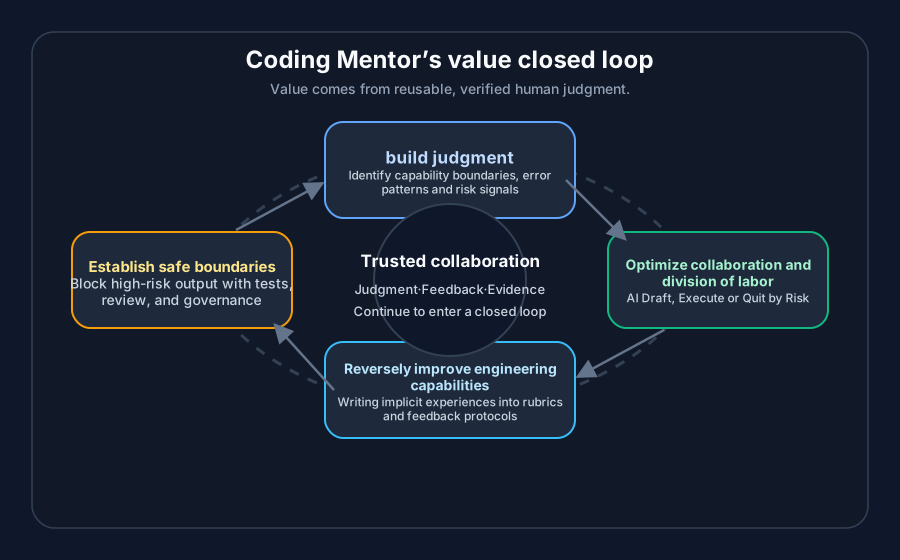
The first level of value is building judgment. You will gradually understand the scenarios in which AI is prone to failure: boundary conditions, concurrency semantics, cross-module dependencies, permission models, performance degradation, and implicit business rules. Judgment is not an abstract experience, but comes from a set of concrete samples: which tasks have failed, what type of failure is, how to verify after correction, and whether similar tasks will occur again.
The second level of value is optimizing collaborative division of labor. AI does not need to be reliable at all tasks to the same degree. For low-risk, automatically verifiable local tasks, AI can be deeply involved; for cross-module, high-risk, and strong business semantics tasks, AI is more suitable as a candidate solution generator; for security boundaries, financial links, data migration, and irreversible operations, AI’s role should be clearly limited. The Mentor perspective lets you stratify by risk, not usage by enthusiasm.
The third layer of value is to reversely improve engineering capabilities. To evaluate AI, you have to make your otherwise implicit engineering judgments clear: what is good code, what is bad smell, what is acceptable technical debt, and what are risks that must be blocked. This process will strengthen problem design, test design, code review, architectural expression and technical communication skills. Being a mentor for AI is essentially making your engineering judgment explicit.
The fourth layer of value is establishing security boundaries. Enterprise-level AI programming is not as simple as “generate faster.” A wrong regularization may bring performance disaster, an unaudited dependency may introduce supply chain risks, and a seemingly harmless permission judgment may expand the scope of data access. Mentor’s responsibility is not to take the blame after the fact, but to set boundaries before the task enters AI collaboration, and to require evidence before the output enters the trunk.
Capability model required by Coding Mentor
Being a coding mentor for AI does not rely on intuition, nor does it rely on a universal prompt. It requires a set of capabilities that can be trained, reused, and teamed.
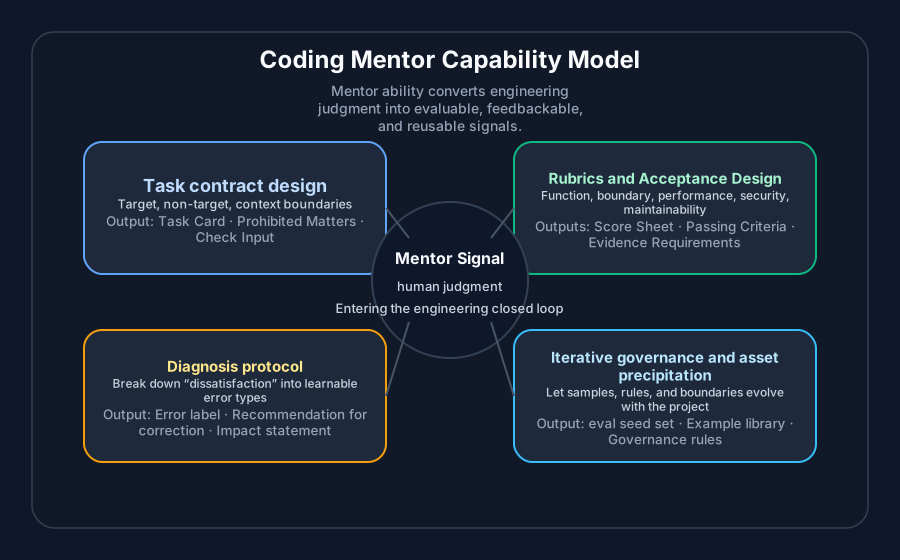
Ability 1: Task Contract Design
The task contract answers “What problem does AI want to solve?” A clear task contract should at least include goals, non-goals, inputs and outputs, context boundaries, acceptance criteria, and prohibitions. Without task contracts, it is easy for AI to overreach: conveniently refactoring files that should not be touched, introducing unnecessary dependencies, or overriding real business rules with seemingly reasonable default assumptions.
The focus of task contract design is not to write long requirements, but to make the constraints executable. For example, “implementing the user export function” is not a qualified task; “without changing the existing permission model and paging protocol, export the audit logs for the last 90 days for administrators. The export task must be executed asynchronously, and failure can be retried, and the main request link cannot be blocked” is close to an evaluable task.
Capability 2: Rubric and Acceptance Criteria Design
Rubric solves “what is good”. There is no point in saying “good”, “not elegant enough”, and “refinement” of AI output, because this feedback cannot be reused and cannot be evaluated. An effective rubric should break down quality into dimensions: functional correctness, boundary coverage, complexity, maintainability, security, performance, compatibility, test evidence.
Rubric weights for different tasks are also different. For a data migration script, idempotence and rollback capabilities are more important than code simplicity; for a high-frequency interface, performance and resource usage must be subject to acceptance; for an internal management page, permission boundaries and operation auditing may be more critical than UI details. What Mentor needs to do is write these weights explicitly.
Capability Three: Error Diagnosis and Feedback Protocol
Error diagnosis answers “why AI is wrong.” If the AI output does not meet expectations, directly asking for “rewrite” will only get another candidate answer and cannot accumulate capabilities. A better approach is to categorize the problems into: misunderstood requirements, missing context, misuse of interfaces, missing boundaries, insufficient testing, security risks, over-engineering, breaking existing constraints.
Feedback protocols answer “how humans hand diagnosis back to AI and the team.” A good piece of feedback not only points out the problem, but also includes evidence, impact, desired correction direction and acceptance method. For example, “empty arrays are not handled here” is just a problem description; “When the input is an empty array, the current implementation returns null, breaking the caller contract; it is expected to return an empty paging object, and an empty input test is supplemented” is learnable feedback.
Capability Four: Iterative Governance and Asset Precipitation
Mentor work is not a one-time conversation, but a long-term mechanism. Every AI collaboration produces assets: task descriptions, candidate solutions, review comments, test results, fixes, reasons for failure, and final adopted versions. If these assets only stay in the chat window, they will disappear quickly; if they can enter the task library, eval set, review rules and example library, they will become compound interest for the team.
Iterative governance also includes boundary maintenance. Model upgrades, tool replacements, code base evolution, and team norm changes will all change the available boundaries of AI. Tasks that were trustworthy in the past may not be safe in the future; tasks that failed in the past may become feasible again due to improved context mechanisms or tool calling capabilities. Mentor needs to continuously update the baseline rather than labeling it all at once.
Minimum Viable Start: Don’t start with the prompt template
If you want to start practicing Coding Mentor today, the least recommended place to start is to collect prompt templates. Templates can lead to short-term improvements, but they rarely build long-term judgment. A better starting point is to choose a real, low-risk, frequently occurring engineering scenario and transform it into a small evaluation loop.
You can start with these five steps:
| step | what to do | output |
|---|---|---|
| Select scene | Choose a task that occurs every week, such as API changes, test enhancements, documentation generation, code reviews | a stable task type |
| Define task contract | Write down input, output, non-targets, context boundaries, and prohibited items | task card template |
| Create a rubric | Define the criteria for passing, partial passing, and failing | Score sheet and error types |
| Collect samples | Document AI output, human feedback, test results, and final corrections | Small eval seed set |
| Cycle review | Look at error distribution, rework reasons and automatable inspection items every week | Capability Boundaries and Improvement Checklist |
Don’t pursue “big and comprehensive” in the first month. Preparing 10 to 20 samples of real tasks is enough to get started: a few bug fixes, a few test enhancements, a few code reviews, a few documentation generations. The key is not quantity, but that each sample can answer three questions: where did the AI go wrong, how do humans judge, and whether there is evidence for improvement.
An executable rhythm is:
| time | focus | Judgment criteria |
|---|---|---|
| Week 1 | Establish a baseline | What is the true performance of AI without additional guidance? |
| Week 2 | Misclassification | Main failures come from misunderstanding of requirements, insufficient context or lack of validation |
| Week 3 | design feedback protocol | What kind of feedback can be structured into task cards, rubrics, and checklists? |
| Week 4 | Introducing regression verification | When the same type of task occurs again, does AI reduce similar errors? |
The value of this starting solution is that it does not rely on a specific model or a specific tool. Models will change, IDEs will change, and agent frameworks will change, but task contracts, rubrics, error types, and verification evidence will continue to be useful.
What will this series bring you?
The main thread of this series is not “how to use AI programming assistants better”, but “how to turn AI programming collaboration into an engineering system that can be evaluated, feedbacked, trained, and managed.” Part 1 is responsible for establishing role reversal: developers are not only users of AI, but also mentors of AI output quality.
Subsequent articles will develop along this main line:
| Chapter | theme | What readers will gain |
|---|---|---|
| Part 2 | Panorama of AI programming ability assessment | Understand the applicable boundaries of benchmarks such as HumanEval, SWE-bench, LiveCodeBench, etc. |
| Part 3 | High-quality programming question design | Learn to transform real engineering tasks into evaluable questions |
| Part 4 | Four-step approach to AI capability assessment | Establish baselines, stress testing, dedicated training and ongoing evaluation processes |
| Part 5 | Feedback methods for collaborating with AI | Design multiple rounds of dialogue, feedback protocols and task acceptance methods |
| Part 6 | Practical cases: feedback protocol, evaluation closed loop, code review and programming education data | See how Mentor signals are generated in different engineering scenarios |
| Part 7 | From delivery to training: Data closed loop for AI programming collaboration | Turn the engineering delivery process into a closed loop of assessment, training and governance |
| Part 8 | From engineering practice to training data: SFT data generation | Understand how high-quality feedback is further processed into training samples |
| Part 9 | future outlook | Determine the direction and organizational impact of AI programming assessment |
When reading this series, you can always grasp one line: only with high-quality judgment can there be high-quality feedback; only with high-quality feedback can there be high-quality data; only with high-quality data can reliable evaluation and model improvement be achieved.
Conclusion: Trustworthy collaboration comes from human judgment system
AI programming assistants will become more and more powerful, the generation speed will become faster and faster, and the tool chain will become more and more automated. But the more so, the more important the human judgment system becomes. Because what is really expensive is not letting AI write a piece of code, but confirming whether this code can enter the real engineering system.
The transformation from user to Coding Mentor can be summarized in four sentences:
| change | meaning |
|---|---|
| From passive acceptance to active definition | Define task boundaries first, then ask AI to generate |
| From blind trust to evidence assessment | Let tests, reviews, and rubrics support judgment |
| From one-time output to long-term feedback | Precipitate failure, correction and adoption results |
| From tool efficiency to organizational capabilities | Turn personal experience into a reusable asset for the team |
AI won’t take on engineering responsibilities for you. It can be a very strong candidate generator, context organizer and automation executor, but trusted collaboration must be built on a human judgment system.
The so-called coding mentor for AI is not ultimately to appear smarter than AI, but to allow AI to have boundaries, evidence, feedback, and a path for continuous improvement when it enters a real engineering system.
References and Acknowledgments
- HumanEval: Evaluating Large Language Models Trained on Code — Chen et al., OpenAI
- SWE-bench: Can Language Models Resolve Real-World GitHub Issues? — Jimenez et al., Princeton
- LiveCodeBench: Holistic and Contamination Free Evaluation — Jain et al., UC Berkeley/MIT/Cornell
- Aider LLM Leaderboards — Paul Gauthier
Series context
You are reading: AI Coding Mentor Series
This is article 1 of 9. Reading progress is stored only in this browser so the full series page can resume from the right entry.
Series Path
Current series chapters
Chapter clicks store reading progress only in this browser so the series page can resume from the right entry.
- Why do you need to be a coding mentor for AI? When AI programming assistants become standard equipment, the real competitiveness is no longer whether they can use AI, but whether they can judge, calibrate and constrain the engineering output of AI. This article starts from trust gaps, feedback protocols, evaluation standards and closed-loop capabilities to establish the core framework of "Humans as Coding Mentors".
- Panorama of AI programming ability evaluation: from HumanEval to SWE-bench, the evolution and selection of benchmarks Public benchmarks are not a decoration for model rankings, but a measurement tool for understanding the boundaries of AI programming capabilities. This article starts from benchmarks such as HumanEval, APPS, CodeContests, SWE-bench, LiveCodeBench and Aider, and explains how to read the rankings, how to choose benchmarks, and how to convert public evaluations into the team's own Coding Mentor evaluation system.
- How to design high-quality programming questions: from question surface to evaluation contract High-quality programming questions are not longer prompts, but assessment contracts that can stably expose the boundaries of abilities. This article starts from Bloom level, difficulty calibration, task contract, test design and question bank management to explain how to build a reproducible question system for AI Coding Mentor.
- Four-step approach to AI capability assessment: from one test to continuous system evaluation Serving as a coding mentor for AI is not about doing a model evaluation, but establishing an evaluation operation system that can continuously expose the boundaries of capabilities, record failure evidence, drive special improvements, and support collaborative decision-making.
- Best Practices for Collaborating with AI: Task Agreement, Dialogue Control and Feedback Closed Loop The core skill of being a Coding Mentor for AI is not to write longer prompt words, but to design task protocols, control the rhythm of conversations, identify error patterns, and precipitate the collaboration process into verifiable and reusable feedback signals.
- Practical cases: feedback protocol, evaluation closed loop, code review and programming education data Case studies should not stop at “how to use AI tools better”. This article uses four engineering scenarios: model selection evaluation, feedback protocol design, code review signal precipitation, and programming education data closed loop to explain how humans can transform the AI collaboration process into evaluable, trainable, and reusable mentor signals.
- From delivery to training: How to turn AI programming collaboration into a Coding Mentor data closed loop The real organizational value of AI programming assistants is not just to increase delivery speed, but to precipitate trainable, evaluable, and reusable mentor signals in every requirement disassembly, code generation, review and revision, test verification, and online review. This article reconstructs the closed-loop framework of AI training, AI-assisted product engineering delivery, high-quality SFT data precipitation, and model evaluation.
- From engineering practice to training data: a systematic method for automatically generating SFT data in AI engineering Following the data closed loop in Part 7, this article focuses on how to process the screened engineering assets into high-quality SFT samples and connect them to a manageable, evaluable, and iterable training pipeline.
- Future Outlook: Evolutionary Trends and Long-term Thinking of AI Programming Assessment As the final article in the series, this article reconstructs the future route of AI Coding Mentor from the perspective of engineering decision-making: how evaluation objects evolve, how organizational capabilities are layered, and how governance boundaries are advanced.
Reading path
Continue along this topic path
Follow the recommended order for AI programming assessment instead of jumping through random articles in the same topic.
Next step
Go deeper into this topic
If this article is useful, continue from the topic page or subscribe to follow later updates.
Loading comments...
Comments and discussion
Sign in with GitHub to join the discussion. Comments are synced to GitHub Discussions