Series · Python
Python Memory Model Deep Dive
From memory architecture to ecosystem flywheel, understanding Python's technical essence in the AI era and the capability building path for developers
Progress is stored in this browser only; without saved progress, reading starts from chapter one.
- Status
- Completed
- Difficulty
- Advanced
- Chapters
- 7/7
- Read time
- 120 min
Guide
Series guide
Understand the reading promise, main path, and reference chapters before entering individual articles.
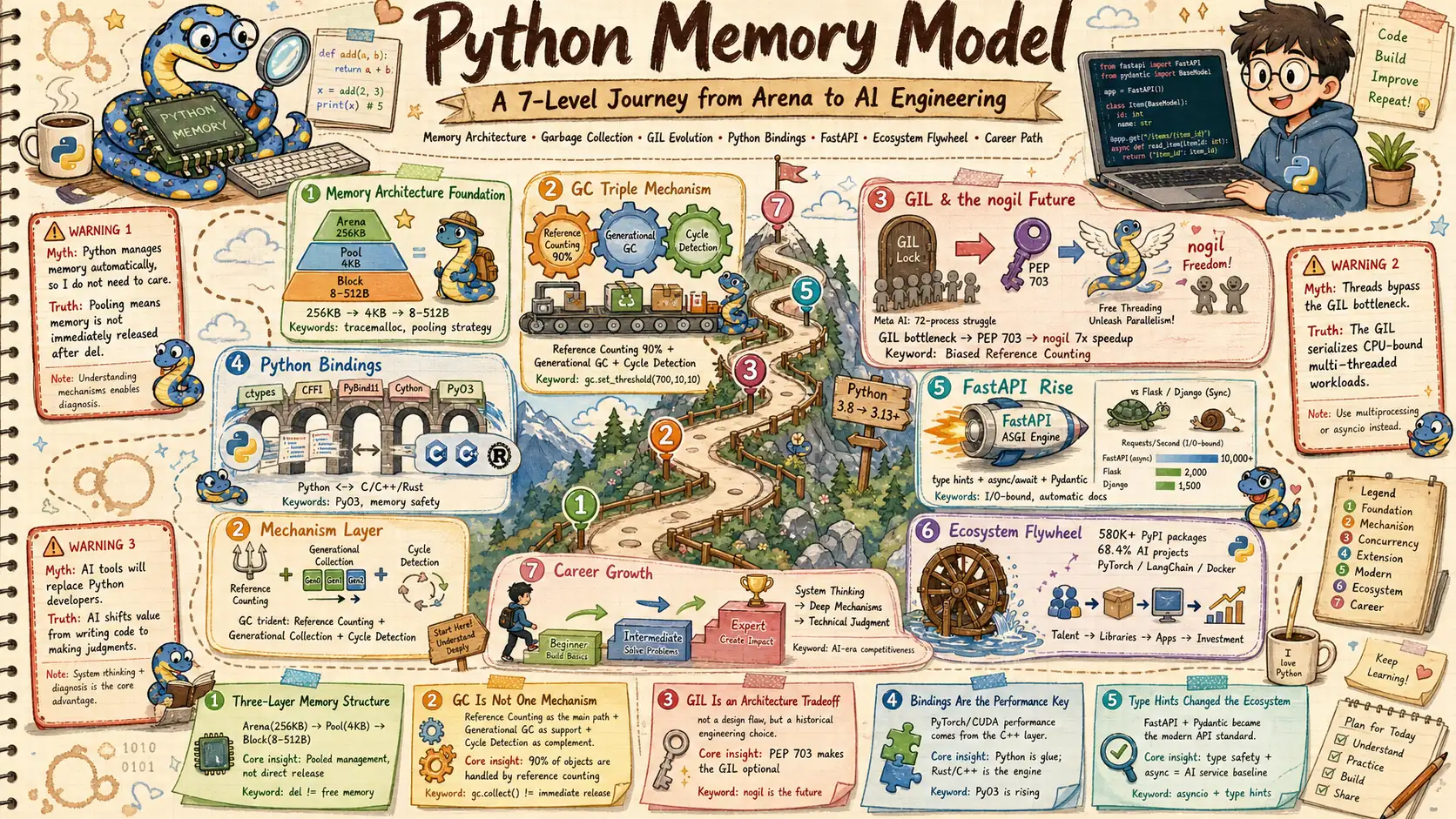
This series starts from the fundamental mechanisms of Python memory management and gradually delves into the ecosystem landscape and developer capability building in the AI era.
Series Articles
- The Three-Layer World of Python Memory Architecture — Understanding the deep reasons why memory usage doesn’t decrease
- Python Garbage Collection Mechanisms — The collaborative work of reference counting, generational GC, and cyclic detection
- PEP 703 and GIL — 72 processes vs 1 process, how the nogil architecture breaks through bottlenecks
- Python Bindings — Comparison of ctypes/CFFI/PyBind11/Cython, the technical essence of glue languages
- FastAPI’s Rise — The engineering value of type annotations and async I/O
- Python’s Ecosystem Flywheel — Why Python dominates large model development
- Capability Building in the AI Era — A practical guide for frontline engineers
Target Readers
- Engineers who want to deeply understand Python’s underlying mechanisms
- Technical personnel working on AI/ML engineering
- Developers who care about technology trends and career development
Learning Path
From memory management fundamentals → GIL concurrency mechanisms → C extension bindings → modern web frameworks → ecosystem landscape → capability building, forming a complete Python technical cognitive system.
Series Path
Read by chapter
Chapter clicks store reading progress only in this browser so the series page can resume from the right entry.
- Original Interpretation: The Three-Layer World of Python Memory Architecture Why doesn't memory drop after deleting large lists? Understanding the engineering trade-offs and design logic of Python's Arena-Pool-Block three-layer memory architecture
- Original Interpretation: Python Garbage Collection - The Three Most Common Misconceptions Deconstructing the three major misconceptions about reference counting, gc.collect(), and del statements, establishing a complete cognitive framework for Python GC mechanisms (reference counting + generational GC + cycle detection)
- Original Analysis: 72 Processes vs 1 Process—How GIL Becomes a Bottleneck for AI Training and PEP 703's Breakthrough Reviewing real production challenges at Meta AI and DeepMind, analyzing PEP 703's Biased Reference Counting (BRC) technology, and exploring the implications of Python 3.13+ nogil builds for large-scale model concurrency
- Original Analysis: Python as a Glue Language—How Bindings Connect Performance and Ease of Use A comparative analysis of ctypes, CFFI, PyBind11, Cython, and PyO3/Rust, exploring the technical nature and engineering choices of Python as a glue language for large models
- Original Analysis: Why FastAPI Rises in the AI Era—The Engineering Value of Type Hints and Async I/O Analyzing Python type hints, async I/O, and FastAPI's rise logic; establishing a feature-capability matching framework for LLM API service development
- Original Analysis: Why Python Monopolizes LLM Development—Ecosystem Flywheel and Data Evidence Synthesizing multi-source data from Stack Overflow 2025, PEP 703 industry testimonies, and LangChain ecosystem to analyze the causes and flywheel effects of Python's dominance in AI
- Original Analysis: Capability Building for Python Developers in the AI Tools Era—A Practical Guide for Frontline Engineers Based on Stack Overflow 2025 data, establishing a capability building roadmap from beginner to expert, providing stage assessment, priority ranking, and minimum executable solutions